BrainFlux
Interactive demonstrations for physics majors. Each one opens already doing something worth watching; change anything and see what happens. Every demo has a drawer of guided experiments, each of which sets itself up with one click. Demos marked beta are new and still being checked.
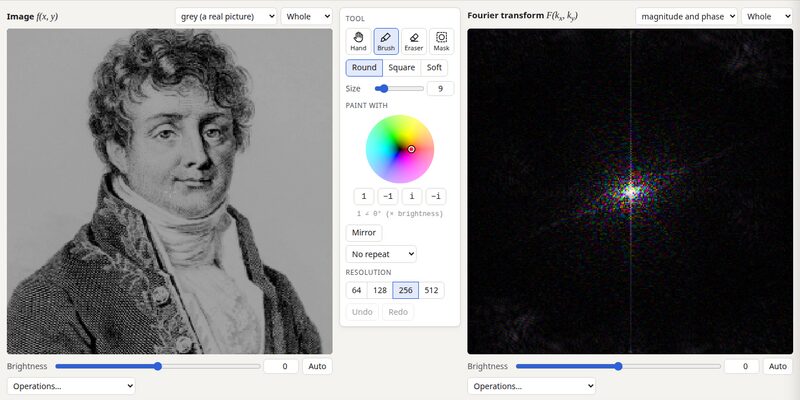
2D Fourier transform
Paint on a picture or on its Fourier transform and watch the other change as you paint. Filter the stripes off Fourier's jacket, swap phases between pictures, find the reciprocal lattice of a crystal.
Fourier analysis · optics · crystallography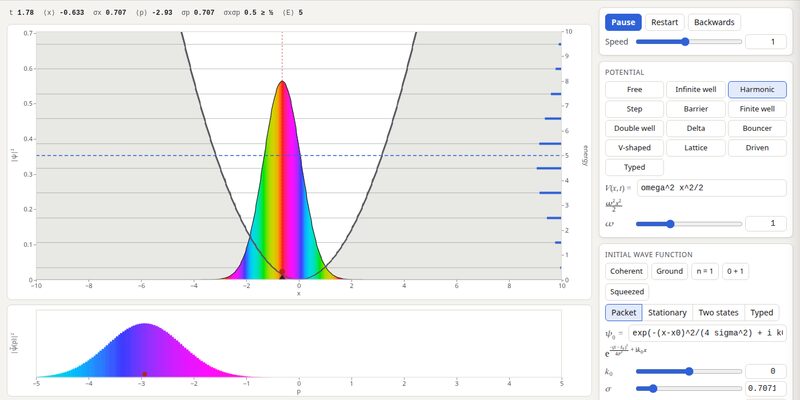
Schrödinger equation in 1D
Pick a potential and a wave function, or type your own, and watch it evolve: spreading, tunnelling, revivals, Bloch oscillations, measurement and collapse.
quantum mechanics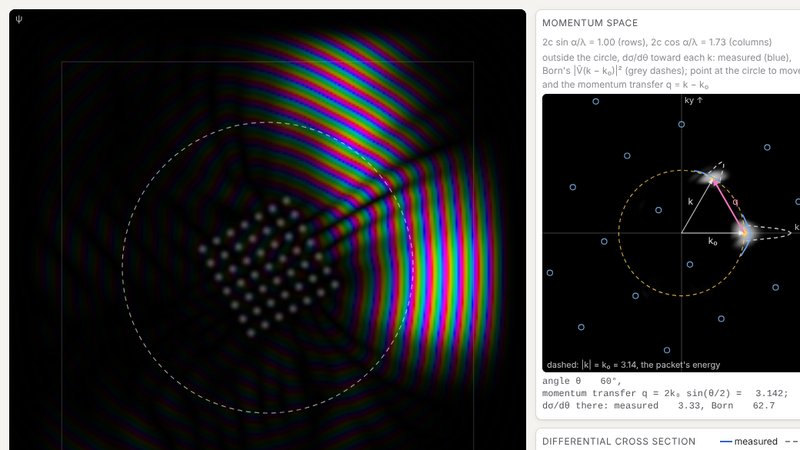
Scattering in 2D
Send wave packets at disks, wells, slits and crystals. The cross section is measured as they pass; compare it with the Born approximation, see the partial waves, watch the shadow carry out the optical theorem, and turn a crystal until it Bragg-reflects.
quantum mechanics · scattering theory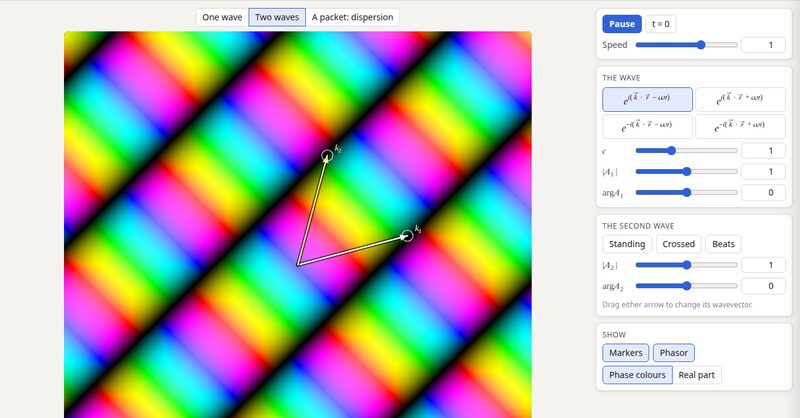
Plane waves
What $e^{i(\vec k\cdot\vec r-\omega t)}$ means: drag the wavevector, try the four sign conventions, superpose waves into standing waves, fringes and beats, and separate phase from group velocity in a packet.
waves · optics · quantum mechanics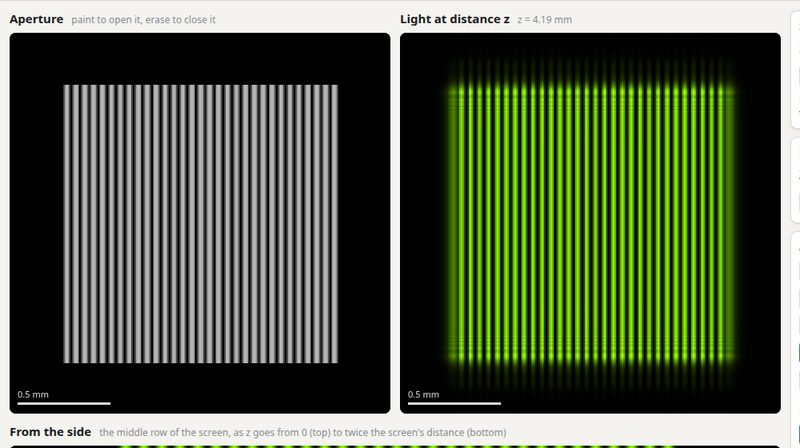
Diffraction
Paint an aperture and move the screen: from a sharp shadow to the Fourier transform. The spot of Arago, the Talbot carpet, zone plates, lenses, white light and speckle.
optics · Fourier analysis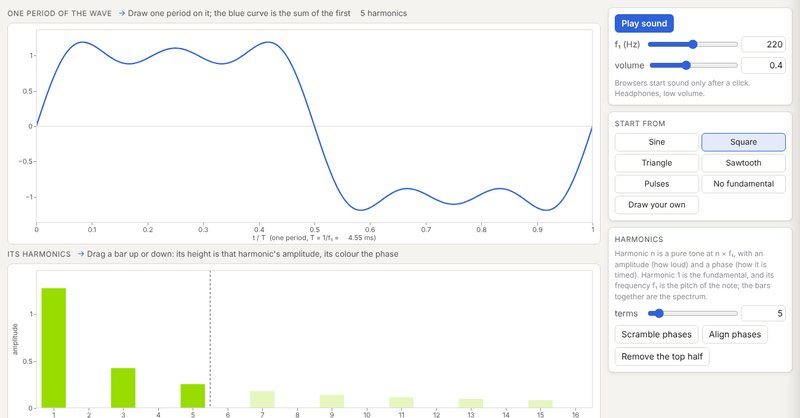
Fourier series you can hear
Draw one period of a wave, or shape its harmonics, and listen. Build a square wave term by term, scramble the phases (the ear doesn't mind), and hear the missing fundamental.
Fourier analysis · sound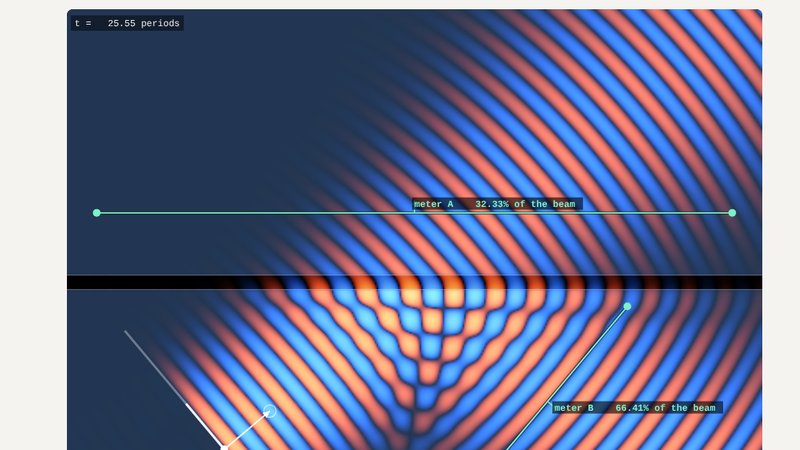
Maxwell's equations in 2Dbeta
Paint glass, metal and absorbers, place a source, and watch light refract, tunnel through a gap, follow a waveguide, focus and ring in a cavity, solved live from Maxwell's equations. Brewster's angle, waveguide cutoff, photonic band gaps and Cherenkov radiation.
electromagnetism · optics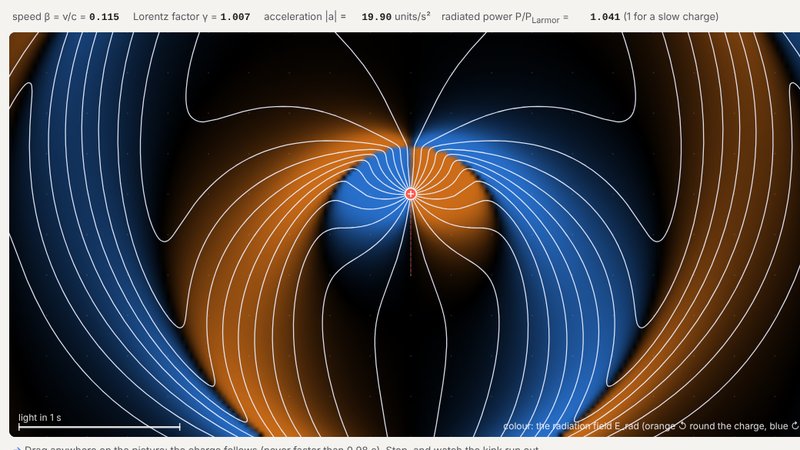
Radiation from a moving chargebeta
Drag a charge and watch its exact electric field: stop it, and a kink of radiation runs out at the speed of light. Dipoles that lean forward, synchrotron beams, Heaviside's pancake, and Liénard's power against Larmor's.
electromagnetism · relativity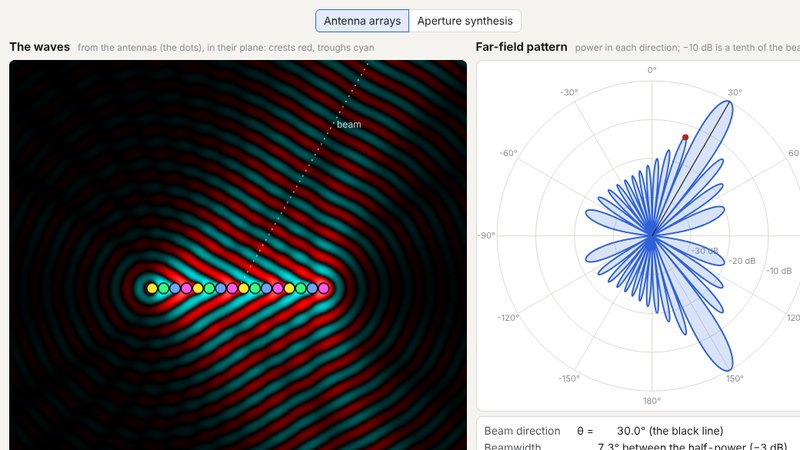
Antenna arraysbeta
Place antennas and set their phases: the far-field pattern is the Fourier transform of the layout. Steer a beam with nothing moving, meet grating lobes, taper the sidelobes away, and focus the waves to a spot.
electromagnetism · Fourier analysis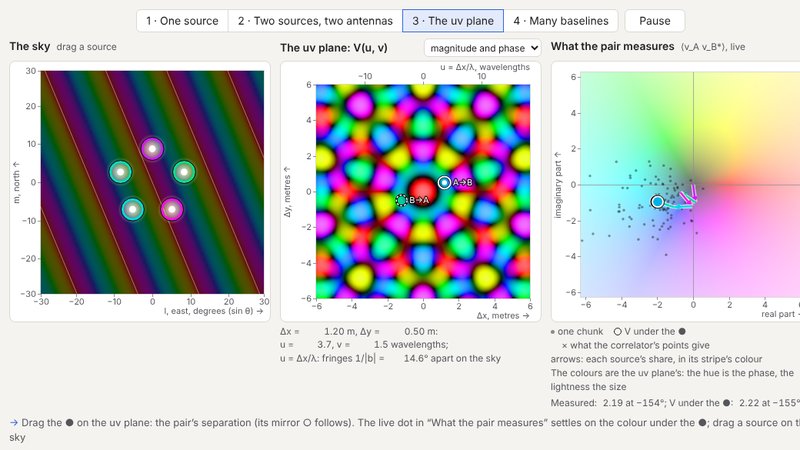
Radio interferometrybeta
Two antennas listening to the same hiss, one of them a moment later: multiply and average, and the delay survives as a phase. Drag the pair across the uv plane to map the Fourier transform of the sky, see why coherent sources break it, then turn on a whole array and the turning Earth and watch the image come out: the dirty image, CLEAN and maximum entropy, each shown at work.
radio astronomy · coherence · Fourier analysis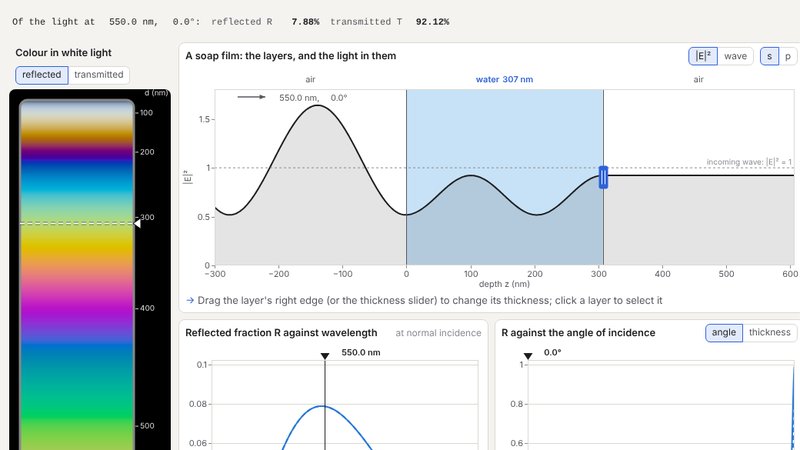
Interfaces and thin filmsbeta
Stack layers of glass, water, metal or any index you type, and see what they do to light: Brewster's angle, total internal reflection and tunnelling across a gap, soap-film colours as the eye sees them, coatings, Bragg mirrors, Fabry–Pérot filters and surface plasmons.
optics · electromagnetism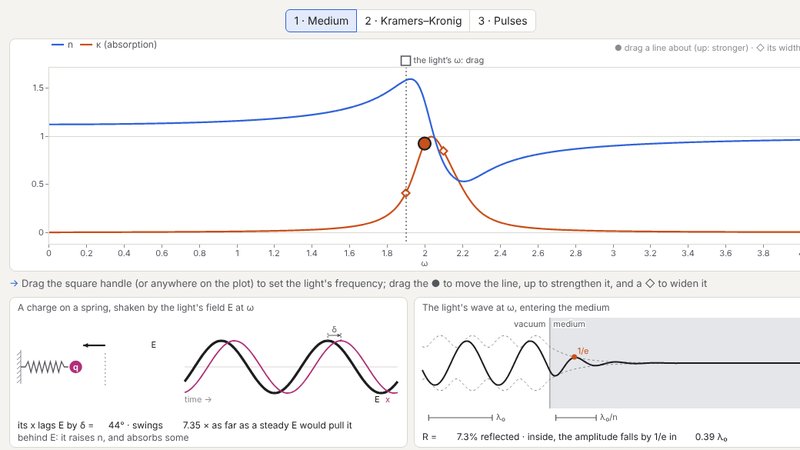
Dispersion and Kramers–Kronigbeta
A charge on a spring, shaken by light: in step below a resonance ($n>1$), a quarter period late on it (absorption), against the field above it ($n<1$). See the wave's wavelength and decay inside, why causality ties the index to the absorption one sliver at a time, and pulses whose envelope goes at $c/n_g$: a group delay, a chirp, a peak that leaves early and a front that never does.
optics · electromagnetism · causality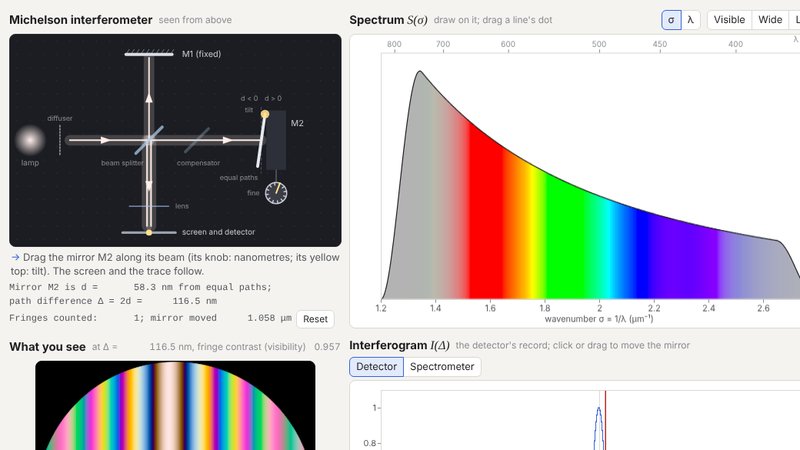
Interferometers and coherencebeta
Move a mirror and count fringes, sweep through the coloured fringes of white light on both sides of equal paths, draw a spectrum and watch its interferogram (or the other way round), resolve the sodium doublet by Fourier-transform spectroscopy, and measure Betelgeuse as Michelson did in 1920.
optics · Fourier analysis · astronomy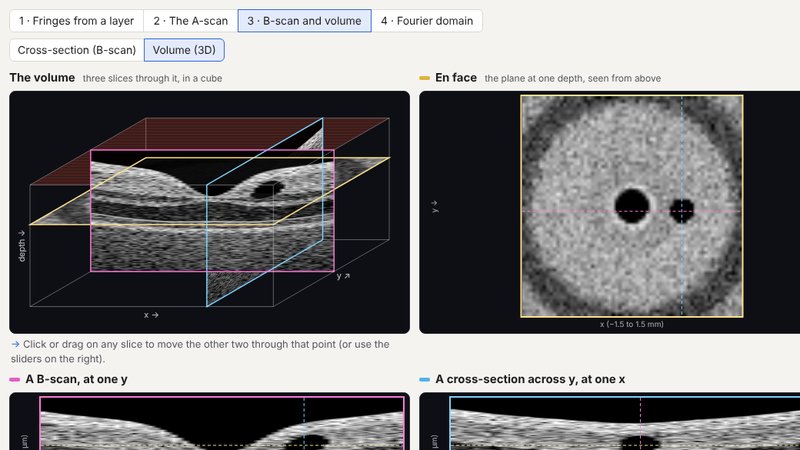
Optical coherence tomographybeta
Start from white-light fringes: put a sample in one arm of a Michelson and every layer makes its own burst of fringes where the paths match. Scan the mirror for an A-scan, step the beam for a cross-section of a retina, average away its speckle, build a 3D volume and slice it along a curved layer, and do it all at once with a spectrometer.
optics · coherence · medical imaging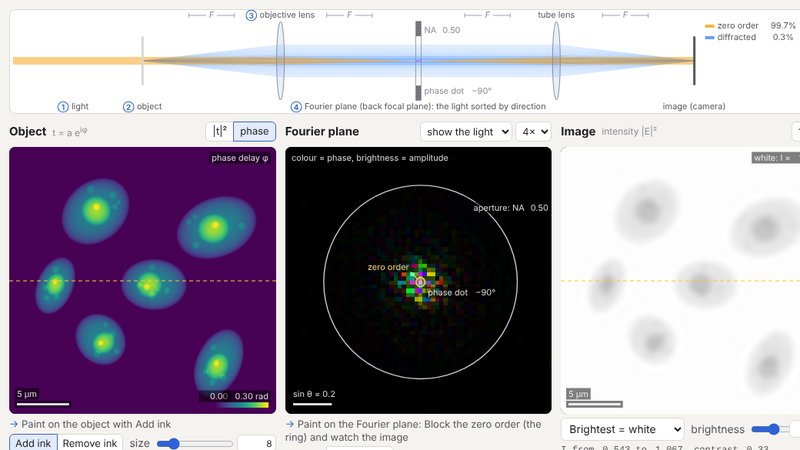
Imaging: Abbe and phase contrastbeta
A microscope as two Fourier transforms, drawn from the side as the light goes through it: block or shift the diffraction orders in the back focal plane and watch the image. Abbe's resolution limit, oblique light, dark field, schlieren, and Zernike's phase dot making transparent cells appear.
optics · Fourier analysis · microscopy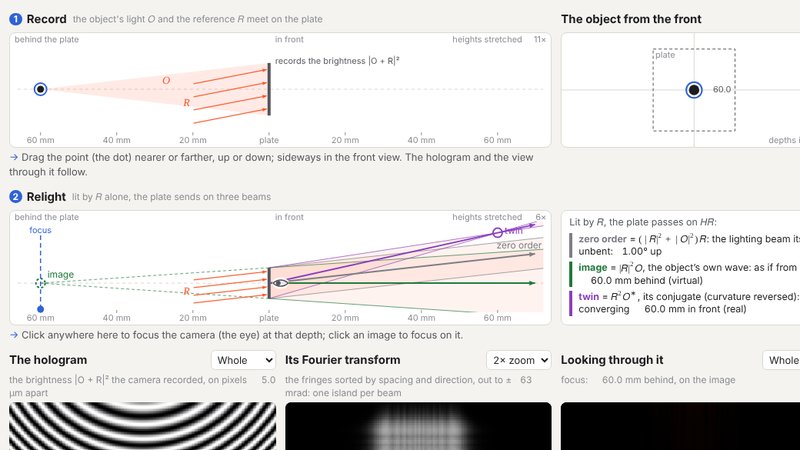
Holographybeta
Record how light from an object interferes with a reference beam, then light the recording and watch it send out three beams: the light straight through, the object's own wave coming back from where the object was, and its twin. Zone plates, Gabor's in-line hologram, the three islands of the off-axis transform, parallax through a window, and a hologram cut to pieces.
optics · Fourier analysis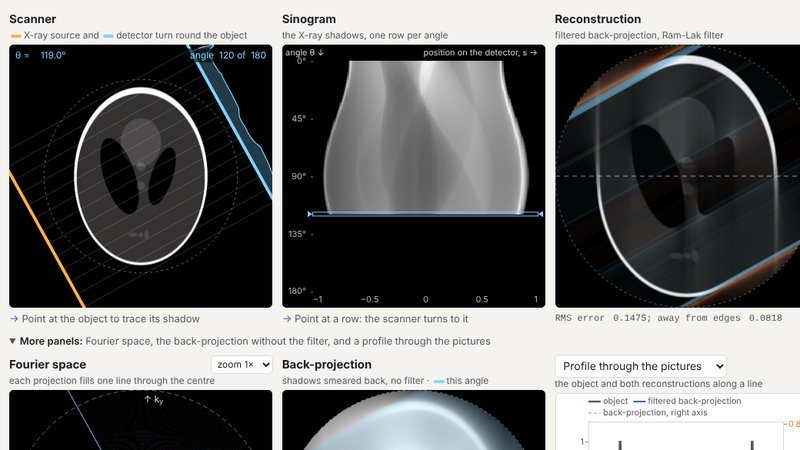
Tomographybeta
How a CT scanner sees inside: watch the sinogram fill as the scanner turns, one angle at a time if you like, back-projection blur and the ramp filter sharpen, and each projection fill a line of Fourier space; point at a spot to see its sinusoid. Streaks from too few angles, the missing wedge, photon noise, aliasing and metal.
imaging · Fourier analysis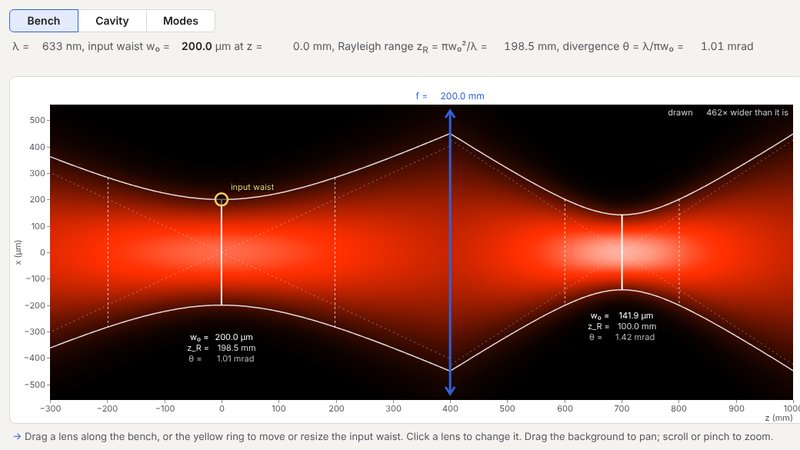
Gaussian beams and laser cavitiesbeta
Drag lenses, mirrors and glass along a laser beam and watch its waist, wavefronts and Gouy phase. Then trap it between two mirrors: the stability diagram, rays, the modes a cavity selects, and their frequencies.
optics · lasers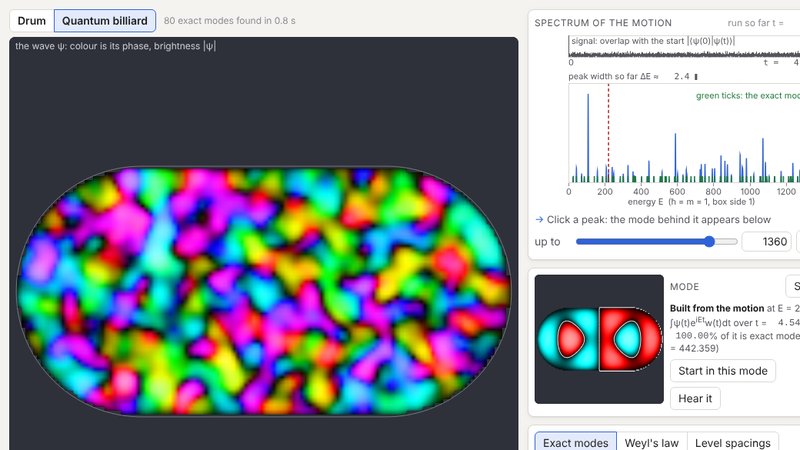
Drums and billiardsbeta
Strike a drum, hear it, and find its modes the way a spectroscopist would, from the Fourier transform of its motion; then draw your own shape and watch it as a quantum billiard: Weyl's law, chaos and level repulsion, scars, and two drums that sound the same.
waves · quantum mechanics · chaos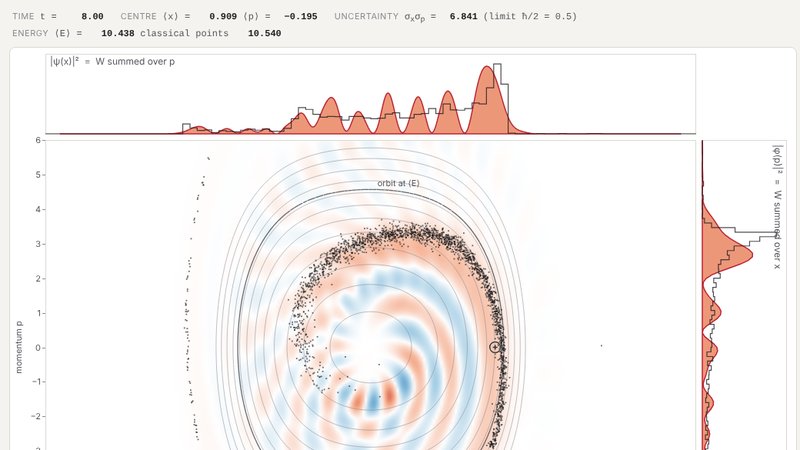
Quantum phase spacebeta
Watch the Wigner function of a wave function evolve beside a cloud of classical particles under the same Hamiltonian: where they agree, and where interference makes $W$ negative. Coherent, squeezed, number and cat states, tunnelling, the Husimi function and tomography.
quantum mechanics · phase space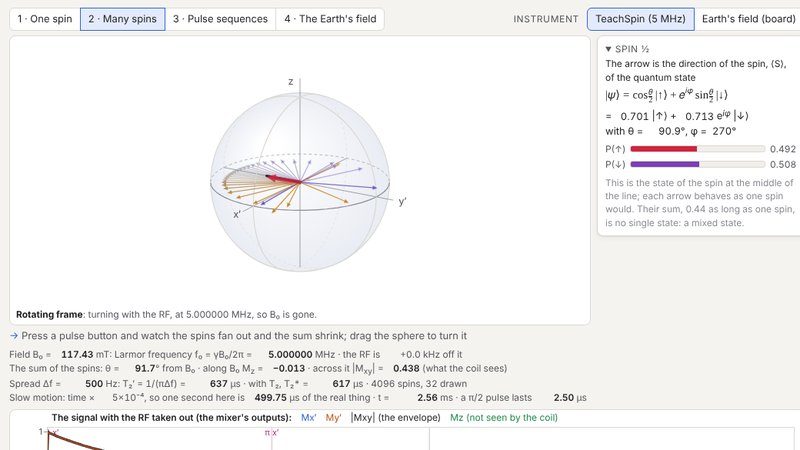
Bloch sphere and NMRbeta
Send pulses into one spin or thousands and watch them on the Bloch sphere: precession, the rotating frame, the free induction decay, spin echoes, T₁ and T₂, noise and averaging. Then the Earth's-field board: polarize a litre of water, switch off fast or slow, tune the tank to the protons with its switches, turn the coil against the Earth's field, and listen to the protons at 1960 Hz.
nuclear magnetic resonance · spin ½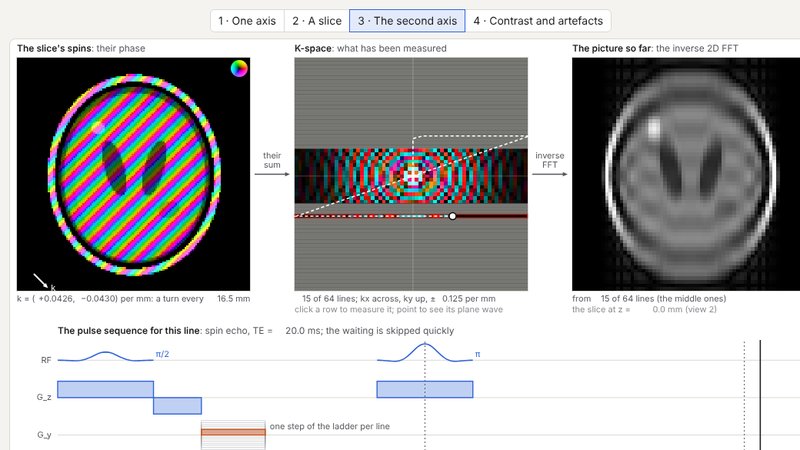
MRI: from spins to an imagebeta
A gradient makes each spin's frequency say where it is, a shaped pulse picks one slice, and phase encoding winds plane waves across it, one row of k-space per line, until the inverse FFT is a picture of a head. Then TR and TE choose what is bright, and a small field of view, few lines, noise and fat's chemical shift show how real scans go wrong; then the same picture in weaker magnets, down to the Earth's field.
magnetic resonance · Fourier imaging · medical physics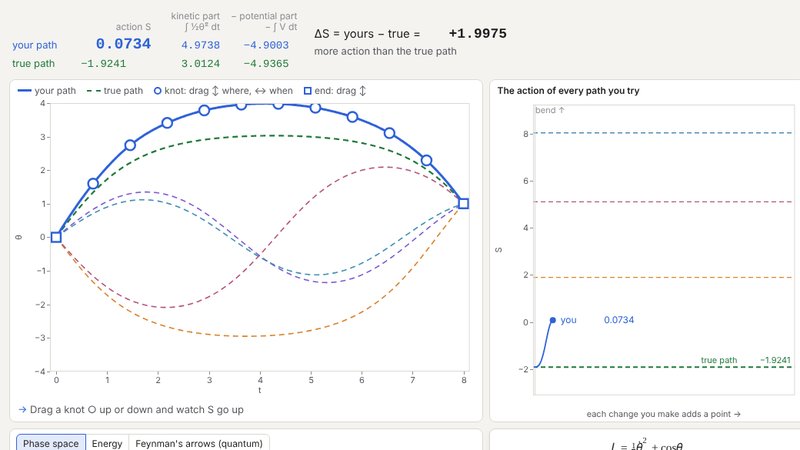
The principle of least actionbeta
Bend the true path between two events and watch its action go up, recorded as you go; see when "least" is really a saddle; the twin paradox, Fermat's principle, the brachistochrone, and Feynman's phasors.
classical mechanics · Lagrangians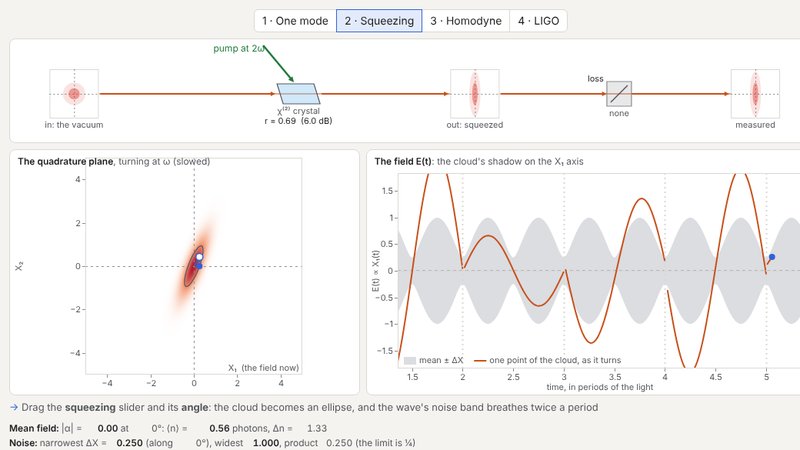
Quantum optics: squeezed light and LIGObeta
One mode of light is a cloud in the quadrature plane: the vacuum's noise, a laser's coherent state, and the crystal that squeezes the cloud into an ellipse, read one direction at a time by homodyne detection with a local oscillator whose phase you turn. Then LIGO: its dark port's vacuum sets the shot noise, a squeezed vacuum injected there takes it below the standard quantum limit, radiation pressure takes it back at low frequency until a filter cavity turns the angle with frequency, and a binary's chirp is pulled out of simulated noise by a matched filter, with and without squeezing.
quantum optics · measurement · gravitational waves