Learn SDR
Harvey Mudd College
Lesson 12 — Phase-Shift Keying (PSK)
Last time, we used a vector of values to modulate the amplitude of the carrier wave, which allowed us to send symbols which could contain more information than a single bit. In binary phase-shift keying (BPSK) we multiply the carrier wave either by 1 or -1. It is common to associate the amplitude of 1 with the binary value 0 and the amplitude of -1 to the binary value 1, which has a simple mapping to the binary XOR operator.
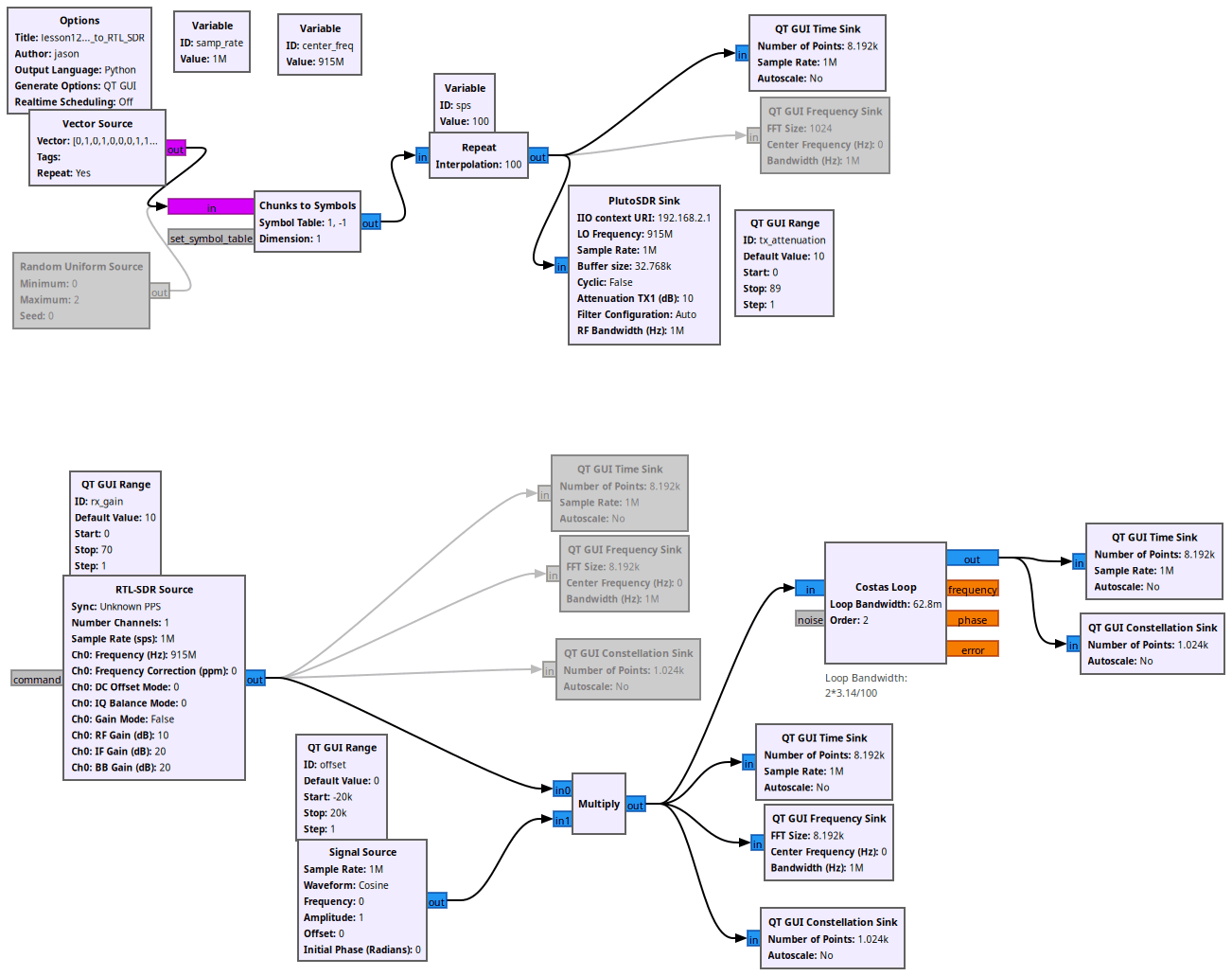
Start with your flow graph from the previous lesson, save a copy with the name BPSK, and then work on the following modifications.
As before, we will use a Vector Source to supply a string of values, only this time our input will be a string of binary digits in a pattern that we will repeat over and over. You can pick whatever pattern you like, but it is helpful to pick something that you can readily recognize in the output [e.g., (0,1,0,1,0,0,1,1,1,1)].
To convert this list of symbols into the values 1 and –1 that we will use to encode, use the Chunks to Symbols block and provide the values (1,-1) as the symbol table.
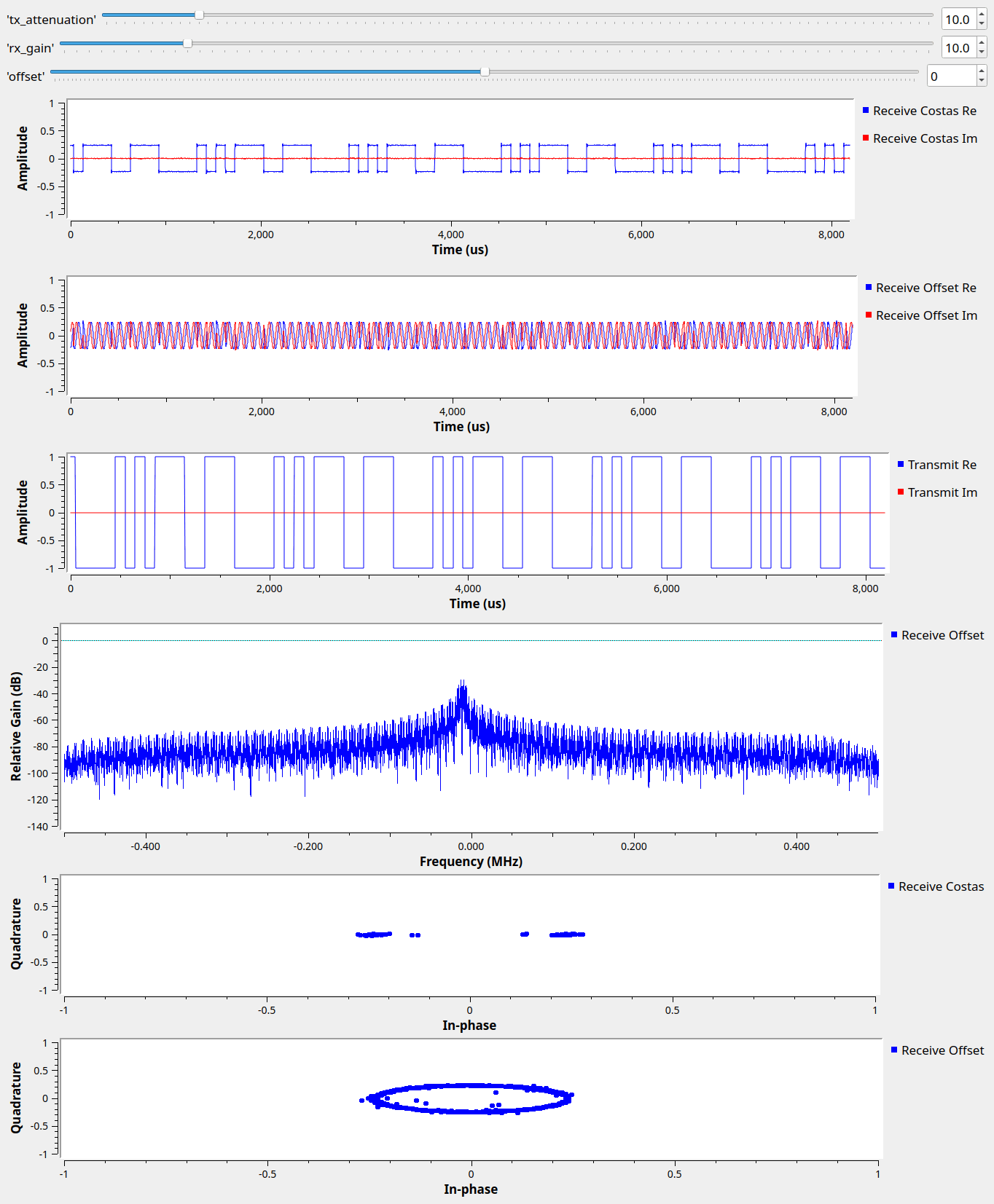
Because the Pluto and RTL-SDR clocks differ, the received constellation spins. In this lesson we cancel the frequency difference by hand with the offset slider (keep its range small, a few kHz, so the slider has enough resolution). Even so the two points slowly rotate, and we cannot tell which is “1” and which is “–1”. The next lessons fix this properly with a frequency-locked loop (Lesson 17), a timing-recovery loop (Lesson 18), and a Costas loop (Lesson 19).
Homework
- Square the incoming signal to adjust the slider and zero out the frequency difference.
Flowgraphs
lesson12_PSK_Pluto_to_RTL_SDR.grc
Running:
All GNURadio flowgraphs are at https://github.com/gallicchio/learnSDR