Learn SDR
Harvey Mudd College
Lesson 20 — Resolving the Phase Ambiguity and Differential Encoding
The Costas loop can lock with the constellation rotated by any multiple of 90° (for QPSK). There is no way to tell from the signal alone which of the four rotations is “right”. Two fixes:
- Differential encoding: transmit the change in symbol from one symbol to the next rather than the symbol itself. A constant rotation then cancels in the receiver’s differential decoder. This costs a little in noise performance (one wrong symbol produces two wrong differences). The Constellation Modulator has a Differential Encoding switch and the receiver uses a Differential Decoder with modulus
constellation.arity(). - A known preamble (a sync word) that tells the receiver which rotation it is in. We don’t do this here, but it is how most real packet modems work.
lesson20_PhaseAmbiguity_and_DifferentialEncoding.grc decodes the received symbols four times, each after an extra rotation by \(1, i, -1, -i\), so you can watch which branch comes out right and that the differentially-decoded bits agree in all four. lesson20_QPSK_modem.grc is the compact version: AGC, FLL, Symbol Sync, Constellation Receiver (symbol sync’s companion that combines the Costas loop with the decision), Differential Decoder, and unpacking to bits.
Flowgraphs
lesson20_PhaseAmbiguity_and_DifferentialEncoding.grc
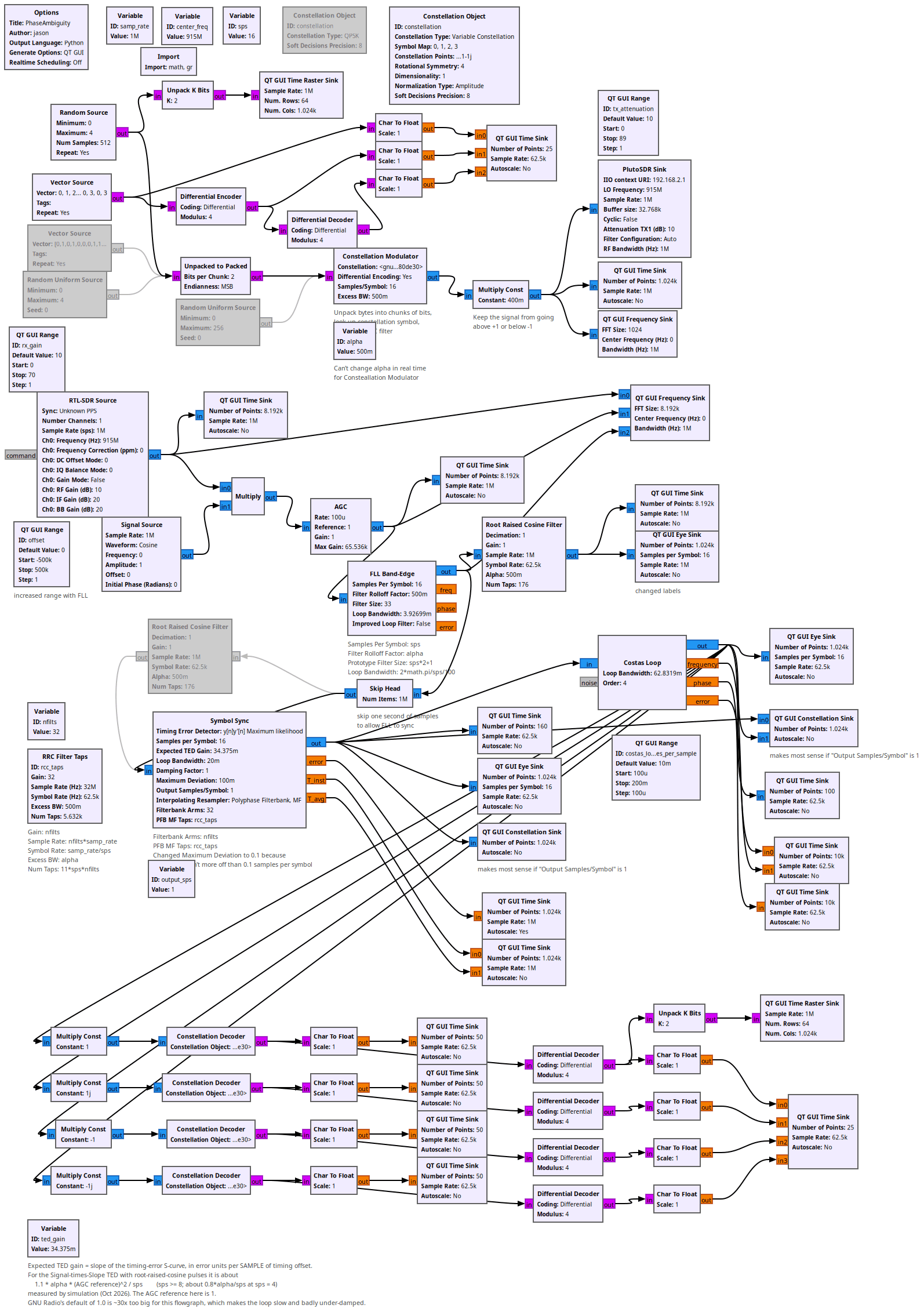
Running:

Other flowgraphs for this lesson:
lesson20_QPSK_modem.grc— Running
All GNURadio flowgraphs are at https://github.com/gallicchio/learnSDR