Learn SDR
Harvey Mudd College
Lesson 25 — MSK and GMSK: FSK done efficiently
No video for this lesson. Lessons 24–38 were drafted in October 2026 with the help of an AI assistant (Claude) in the spirit of the lessons above, and tested on the same RTL-SDR / PlutoSDR / B210 setup. They are less polished than the video lessons; corrections and pull requests are welcome.
Lesson 24’s FSK switches between two tones \(\pm h/(2T_b)\) away from the carrier, where \(T_b\) is the bit time and \(h\) is the modulation index. Two things make it wasteful: the tones are far apart, and the frequency jumps abruptly at every bit edge, which splatters power far from the carrier (Lesson 14 again: sharp edges in time mean wide spectra).
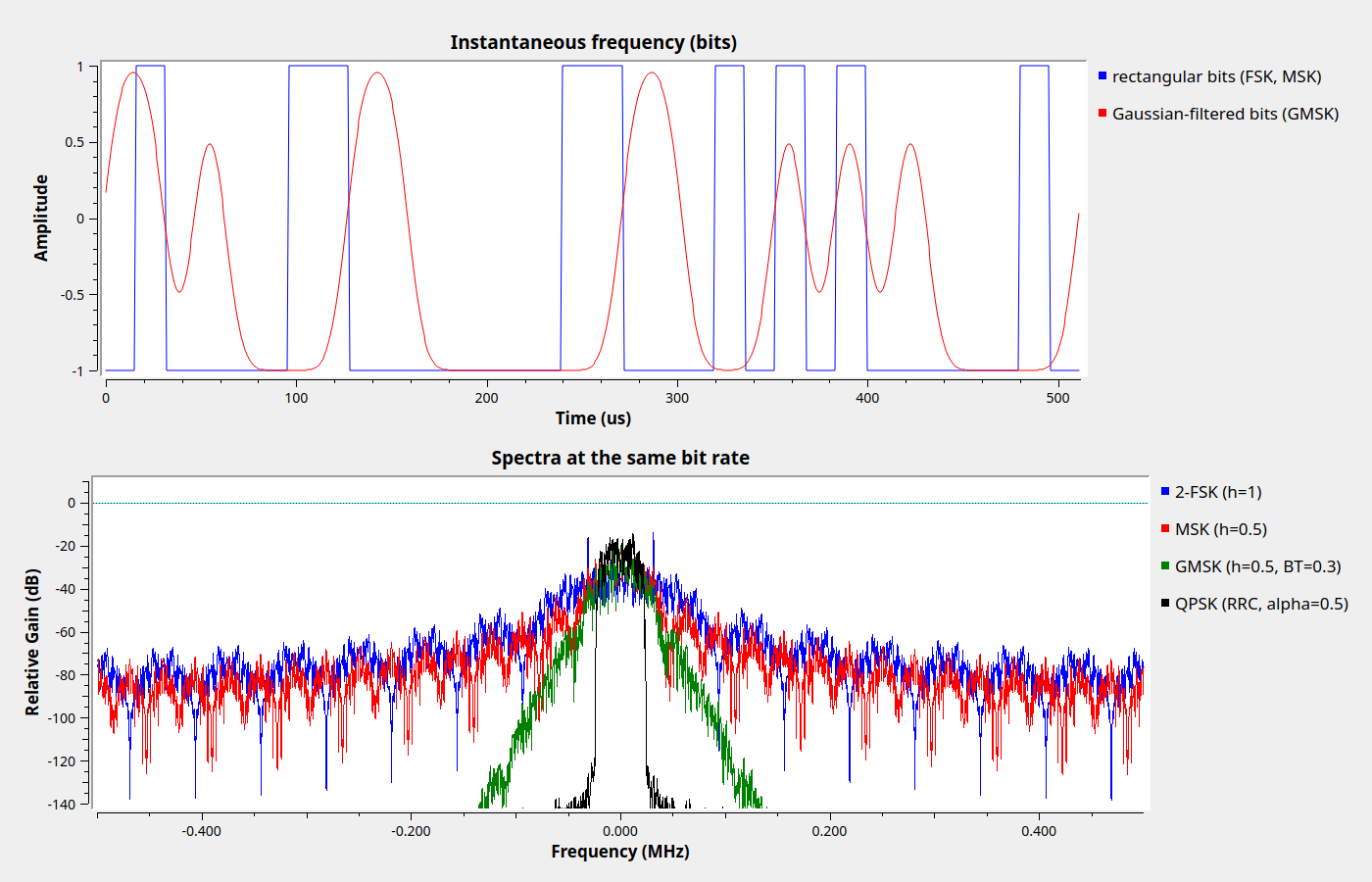
- MSK (minimum-shift keying) uses \(h = 0.5\), the smallest value for which the two tones are still orthogonal over one bit. The phase advances or retreats by exactly 90° per bit and is continuous, so the envelope is perfectly constant.
- GMSK additionally passes the bit stream through a Gaussian low-pass filter before the frequency modulator, so the frequency moves smoothly instead of jumping. The filter’s bandwidth times the bit time,
BT, sets how much the bits are smeared into each other (GSM uses 0.3, Bluetooth 0.5). The sidelobes vanish; the price is a little intersymbol interference. - Constant envelope is the big attraction: the power amplifier can be run flat out (non-linear) without distorting the signal. That is why GSM, Bluetooth, AIS and many satellite links use it.
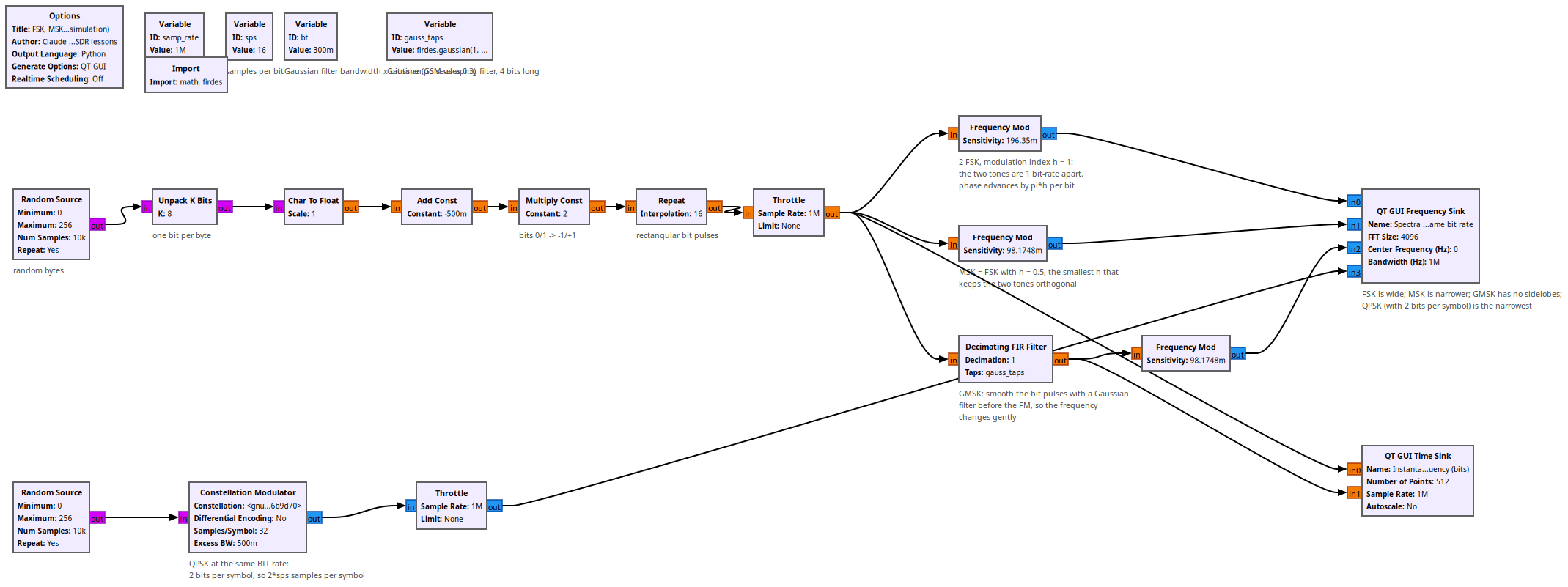
lesson25a_FSK_MSK_GMSK_spectra.grc builds all three from parts (bits → Gaussian filter → Frequency Modulator with sensitivity \(\pi h/\texttt{sps}\)) and plots their spectra at the same bit rate, next to QPSK for comparison.
lesson25b_GMSK_Pluto_to_RTL.grc sends GMSK over the air using GNU Radio’s GMSK Mod block and demodulates it like Lesson 24: channel filter about one bit-rate wide, Quadrature Demod, then a DC Blocker — the frequency error between the two radios appears as a DC offset after FM demodulation, and this high-pass filter removes it (it plays the role of the FLL of Lesson 17). The Symbol Sync block (Lesson 18, float version, Mueller & Müller detector) picks one sample per bit and a slicer turns it into bits. The TED gain of 0.06 was measured in simulation for this signal, as in Lesson 18.
Things to try
- In 25a, change
btto 0.5 and to 10 (which is just MSK). Change the FSK branch’s \(h\) to 2, the value Lesson 24 used. - In 25b, lower
tx_attenuationuntil the eye closes. How does the bit error rate compare with BPSK (Lesson 18) at the same power? (FM demodulation “throws away” about 3 dB.)
Flowgraphs
lesson25a_FSK_MSK_GMSK_spectra.grc
Running: spectra of 2-FSK, MSK, GMSK and QPSK at the same bit rate, and the rectangular vs. Gaussian-filtered bit streams:
Other flowgraphs for this lesson:
lesson25b_GMSK_Pluto_to_RTL.grc— Running over the air: demodulated bits, FM-demodulator output before/after the DC blocker, spectra, eye diagram
All GNURadio flowgraphs are at https://github.com/gallicchio/learnSDR