Learn SDR
Harvey Mudd College
Lesson 26 — More bits per symbol: 8PSK and 16-QAM
No video for this lesson. Lessons 24–38 were drafted in October 2026 with the help of an AI assistant (Claude) in the spirit of the lessons above, and tested on the same RTL-SDR / PlutoSDR / B210 setup. They are less polished than the video lessons; corrections and pull requests are welcome.
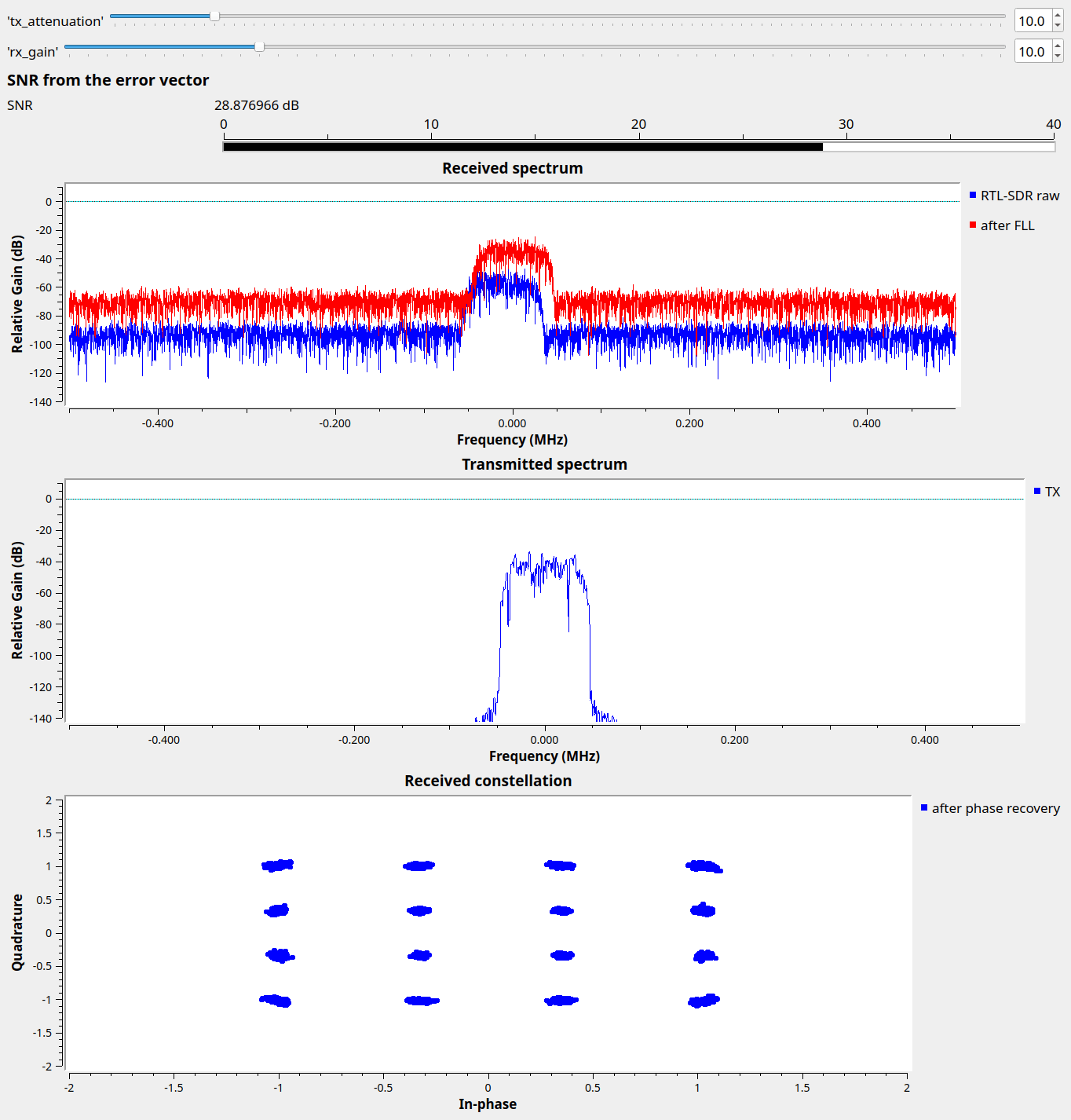
QPSK sends 2 bits per symbol. If the symbol rate (and so the bandwidth, Lesson 14) is fixed, the only way to send faster is to use more constellation points: 8PSK has 8 points on the circle (3 bits per symbol), 16-QAM has a 4×4 grid with three different amplitudes (4 bits per symbol), 64-QAM a 8×8 grid, and so on up to the 1024-QAM of cable modems and Wi-Fi 6.
Nothing is free: the points get closer together, so the same noise causes more decision errors. Going from QPSK to 16-QAM needs about 4 dB more signal-to-noise ratio for the same error rate, 64-QAM about 8.5 dB more. That is why your Wi-Fi or phone negotiates the constellation: dense when the signal is strong, QPSK when it is weak.
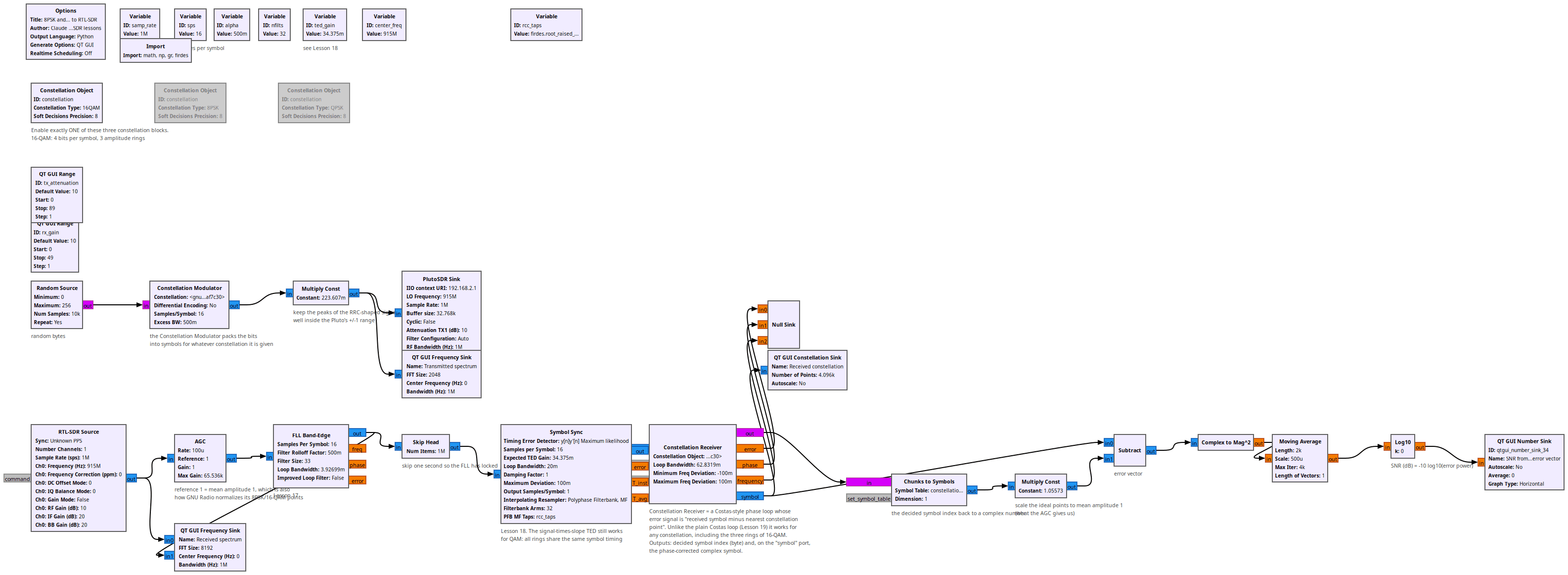
The flowgraph is Lesson 20’s modem with three Constellation Object blocks (enable one): QPSK, 8PSK, 16-QAM. Two things change in the receiver:
- The plain Costas Loop of Lesson 19 only knows about PSK; for QAM we use the Constellation Receiver block, whose phase error is simply “received symbol minus nearest constellation point”. It works for any constellation and also outputs the decided symbol.
- The AGC reference of 1 now matters: GNU Radio normalizes its 8PSK and 16-QAM points to mean amplitude 1, and the receiver has to see the rings at the right radii.
An error vector chain at the bottom (received symbol minus ideal symbol, averaged) gives a live SNR estimate, as in Lesson 27.
Things to try
- Raise
tx_attenuationuntil the 16-QAM clusters merge, note the SNR; switch to QPSK and do the same. - 8PSK with the Costas loop set to order 8 also works; try replacing the Constellation Receiver to see.
- Why does 16-QAM, unlike PSK, not have a constant envelope? Look at the transmitted time signal.
Flowgraphs
Running over the air with 16-QAM: the 4x4 grid after phase recovery, and the error-vector SNR meter:
All GNURadio flowgraphs are at https://github.com/gallicchio/learnSDR