Learn SDR
Harvey Mudd College
Lesson 28 — Multipath and a simple adaptive equalizer (simulation)
No video for this lesson. Lessons 24–38 were drafted in October 2026 with the help of an AI assistant (Claude) in the spirit of the lessons above, and tested on the same RTL-SDR / PlutoSDR / B210 setup. They are less polished than the video lessons; corrections and pull requests are welcome.
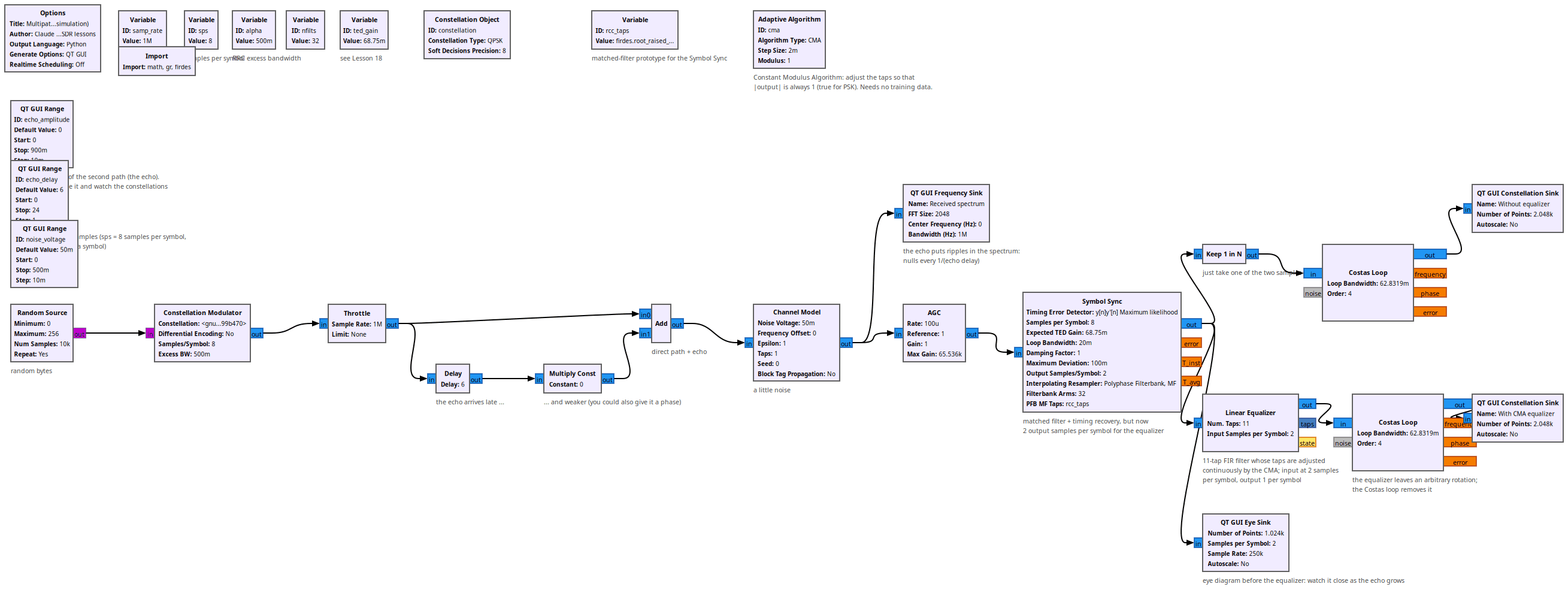
Indoors, a radio signal arrives several times: directly, and via reflections from walls and furniture a little later. The receiver sees the sum. This flowgraph builds the simplest such channel from blocks you know: the signal plus a copy Delayed by echo_delay samples and scaled by echo_amplitude.
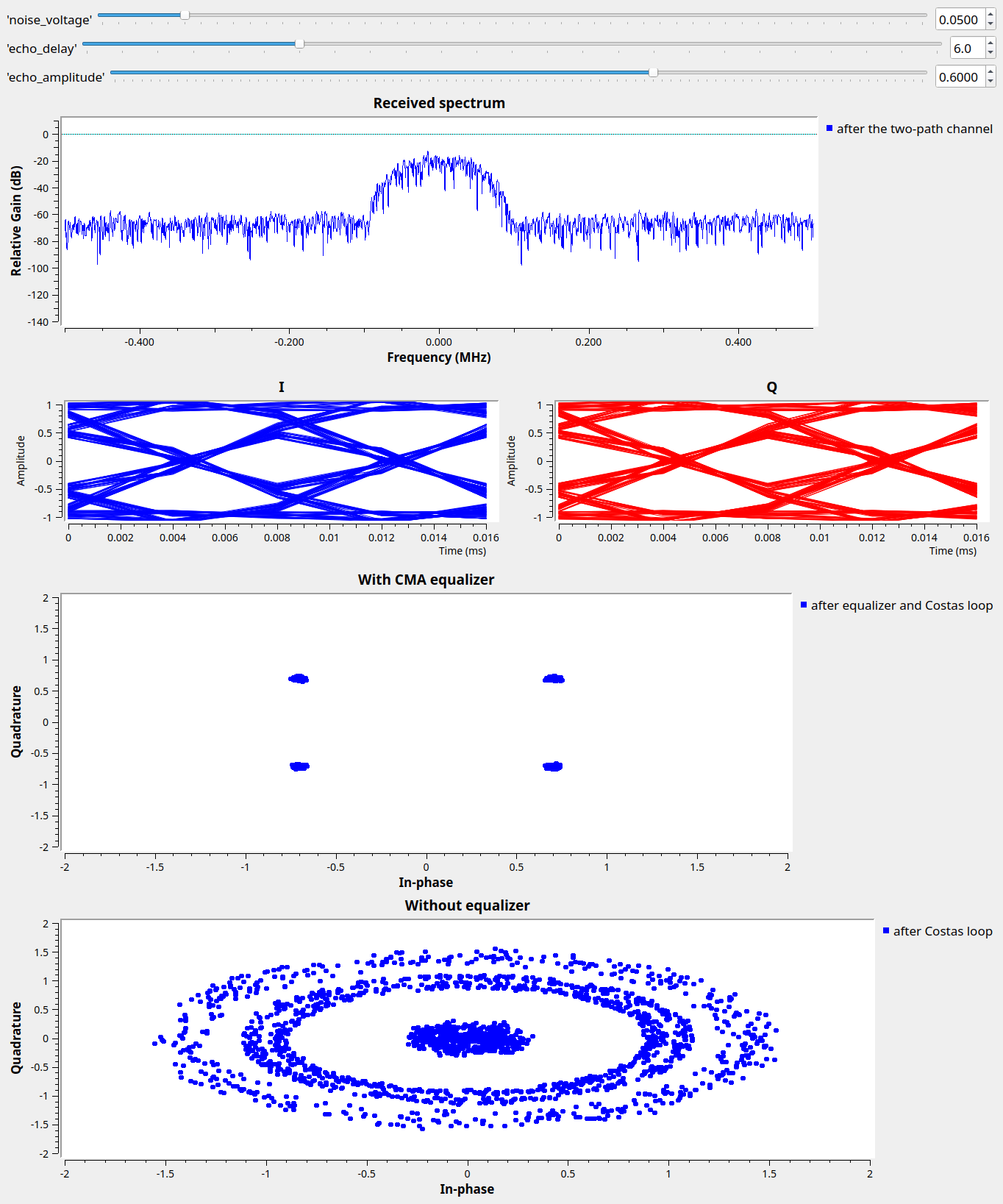
Two things happen. In frequency, the echo puts a ripple on the spectrum with nulls every \(1/\tau\) (watch the spectrum sink as you raise the amplitude) — the channel is now frequency selective. In time, each symbol leaks into the next: intersymbol interference. The eye diagram closes and the QPSK constellation turns into a mess of rings, even though there is almost no noise.
| The fix is an equalizer: an FIR filter that approximately undoes the channel. Since the channel is unknown, the filter’s taps are found adaptively. The Linear Equalizer block here uses the constant modulus algorithm (CMA): it nudges the 11 taps, every symbol, in the direction that makes $$ | y | $$ closer to 1 — which must be true for any PSK signal. It needs no training data, which is why it is popular for broadcast-type signals. The equalizer runs at 2 samples per symbol (a fractionally spaced equalizer, so it also fixes small timing errors) and leaves an arbitrary rotation, which the Costas loop after it removes. |
Things to try
echo_delay= 8 (exactly one symbol) with amplitude 0.9: the hardest case. Then 16.- The CMA
step_sizeis a loop bandwidth: too small and it never converges, too large and the taps jitter. Try 0.0005 and 0.02. - OFDM (Lesson 30) is the other way of dealing with multipath.
Flowgraphs
lesson28_Multipath_Equalizer.grc
Running with a 0.6-amplitude echo 6 samples late: without the equalizer the constellation is rings; with the CMA equalizer the four points are back:
All GNURadio flowgraphs are at https://github.com/gallicchio/learnSDR