Learn SDR
Harvey Mudd College
Lesson 29 — Finding packets and the phase ambiguity with a known preamble (simulation)
No video for this lesson. Lessons 24–38 were drafted in October 2026 with the help of an AI assistant (Claude) in the spirit of the lessons above, and tested on the same RTL-SDR / PlutoSDR / B210 setup. They are less polished than the video lessons; corrections and pull requests are welcome.
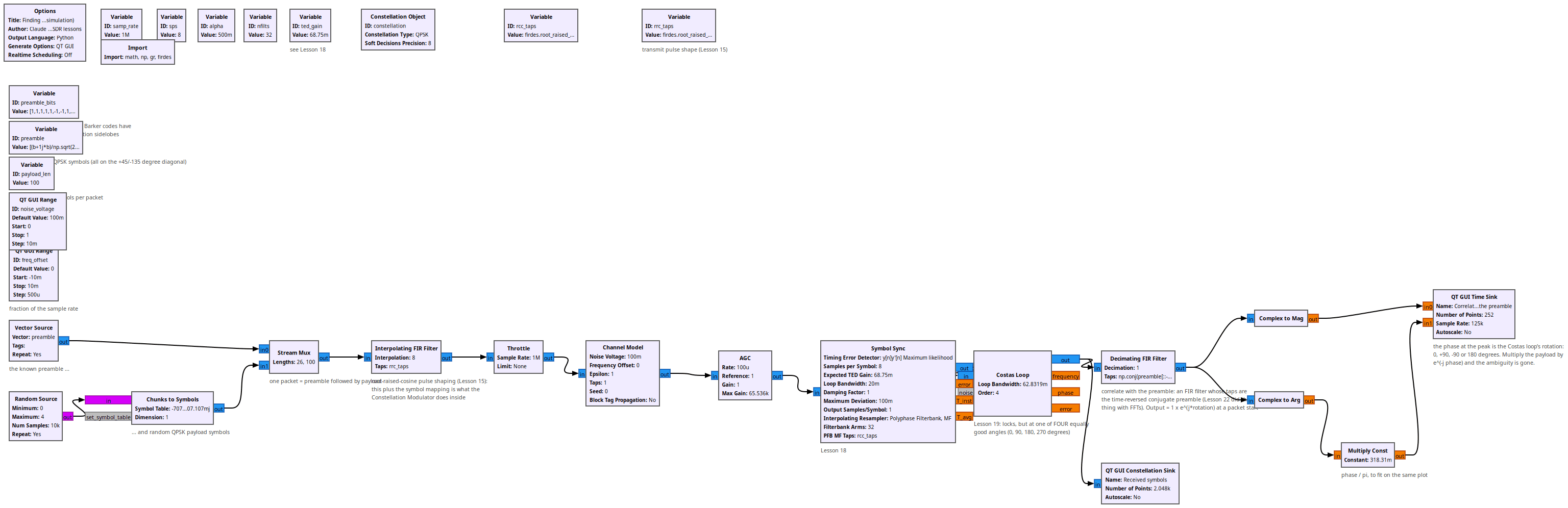
Lesson 20 removed the Costas loop’s 90° ambiguity with differential encoding. Real packet radios do it differently: every packet starts with a preamble the receiver knows. Correlating the received symbols with the preamble gives a sharp peak at the start of every packet, and the phase of that peak is exactly the rotation the Costas loop has settled on.
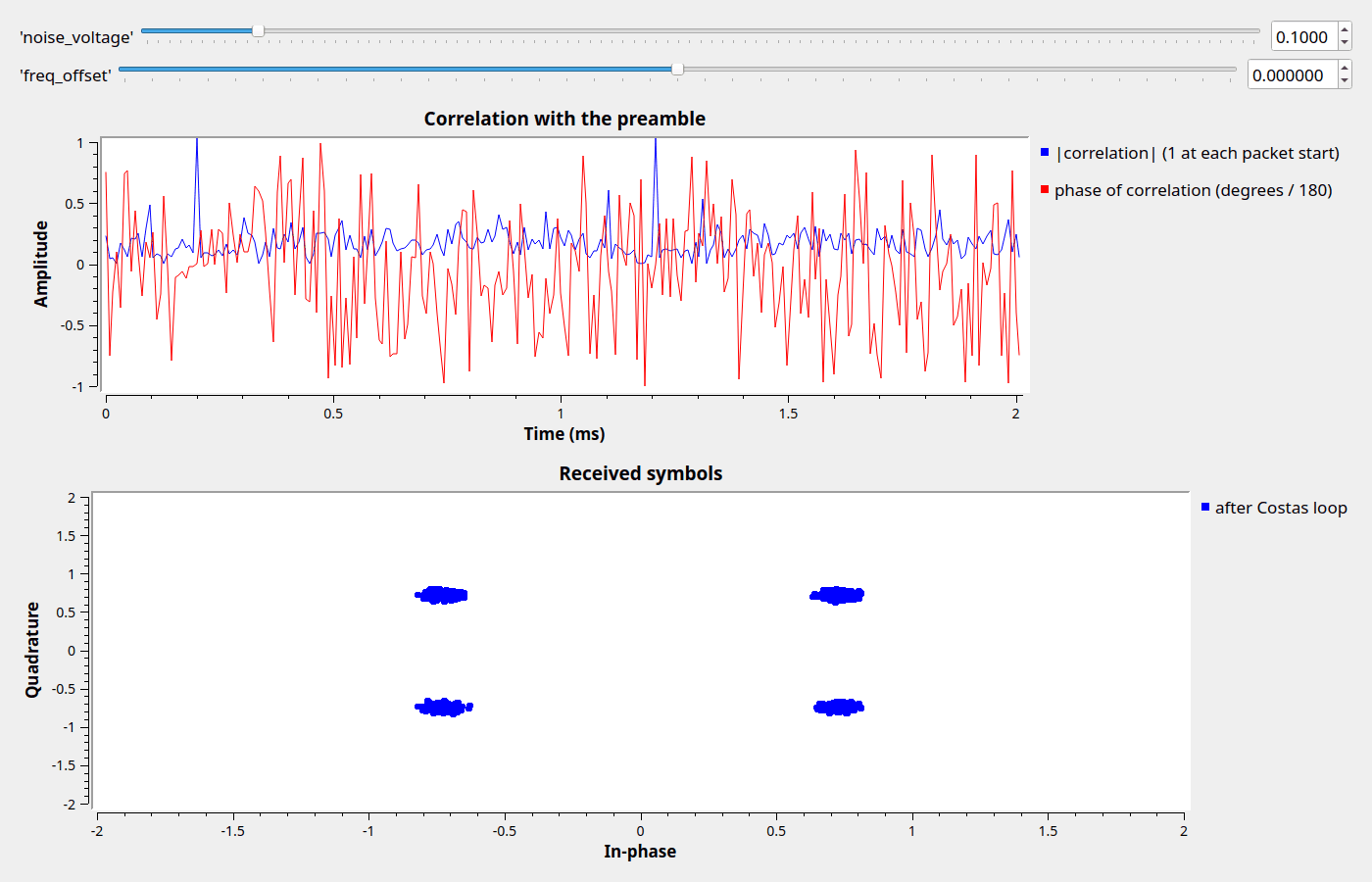
The transmitter builds packets in the symbol domain: a Stream Mux alternates between a Vector Source holding the preamble (a 13-chip Barker code, twice, as QPSK symbols) and random payload symbols, and an interpolating root-raised-cosine filter shapes the pulses (this is what the Constellation Modulator does inside, Lesson 15). The receiver is Lessons 18 and 19, followed by one new block: an FIR filter whose taps are the time-reversed, conjugated preamble. A filter like that is a correlator (Lesson 22 did the same thing with FFTs). Its output has magnitude 1 at each packet start and noise-like values elsewhere; the output’s phase at the peak is 0°, ±90° or 180°.
Barker codes are used because their correlation sidelobes are as small as possible (1/13); Wi-Fi, LTE and GPS all use sequences with this property.
Things to try
- Multiply the payload by \(e^{-i\theta}\) with \(\theta\) the phase at the peak and the ambiguity is gone. (Homework: hold the phase with a Sample and Hold block triggered at the peak.)
- Shorten the preamble to one Barker code: the peaks get noisier. Lengthen it: how many symbols do you waste per packet?
- GNU Radio’s Correlation Estimator block does all of this (and more) in one block and tags the stream with the packet start and phase.
Flowgraphs
lesson29_Preamble_Correlation.grc
Running: the correlation magnitude is 1 at every packet start (every 126 symbols), noise-like elsewhere:
All GNURadio flowgraphs are at https://github.com/gallicchio/learnSDR