Learn SDR
Harvey Mudd College
Lesson 30 — OFDM: many slow carriers instead of one fast one (simulation)
No video for this lesson. Lessons 24–38 were drafted in October 2026 with the help of an AI assistant (Claude) in the spirit of the lessons above, and tested on the same RTL-SDR / PlutoSDR / B210 setup. They are less polished than the video lessons; corrections and pull requests are welcome.
Lesson 28 showed that an echo a fraction of a symbol long wrecks a single-carrier signal. Orthogonal frequency-division multiplexing takes the opposite approach: instead of one carrier at 1 Msymbol/s, use 48 carriers at 15.6 ksymbol/s each. Each symbol is now 64 µs long, so an echo of a microsecond barely matters. The carriers are spaced exactly one symbol rate apart, which makes them orthogonal — an FFT separates them perfectly — and the transmitter is just an inverse FFT of the symbols you want on each carrier.
Two tricks make it work: a cyclic prefix (the last 16 samples of every symbol are copied in front of it) absorbs any echo shorter than 16 samples, and a few pilot carriers with known symbols let the receiver measure and undo the channel’s phase and amplitude on every carrier. Wi-Fi, LTE/5G, DVB-T and DAB are all OFDM; this flowgraph uses the Wi-Fi 802.11a carrier layout.
GNU Radio’s OFDM Transmitter and OFDM Receiver hier blocks do the heavy lifting (packet detection with a Schmidl & Cox sync word, frequency correction, FFT, equalization, header and payload decoding). Random bytes go in as 96-byte packets; the receiver prints a tag per decoded packet and the bytes come out on the time sink.
Things to try
- Raise
echo_amplitudeto 0.9: the Lesson 28 echo (3 samples) is harmless. Change the Delay block to 20 samples (longer than the prefix) and it is not. freq_offsetis in units of the carrier spacing: the receiver copes with ±½, larger offsets need the sync word’s coarse correction.- OFDM has a large peak-to-average power ratio (look at the time sink), which is why the signal is scaled to 0.05 before the Pluto.
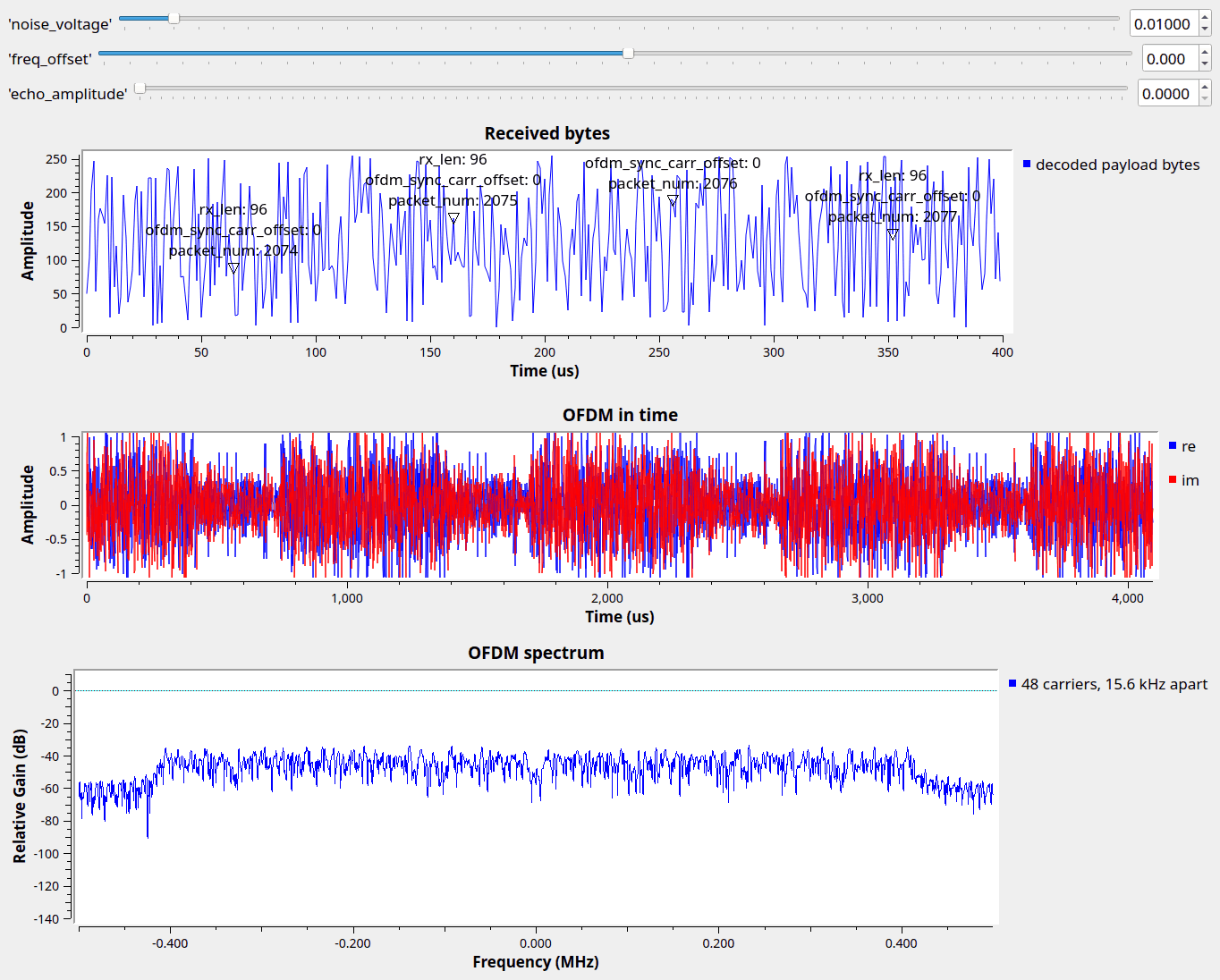
lesson30b_OFDM_Pluto_to_RTL.grcis the same thing over the air at 915 MHz: the OFDM receiver’s sync word and pilots absorb the Pluto/RTL-SDR clock difference (about one carrier spacing) without any help, and the 96-byte packets come out decoded.
Flowgraphs
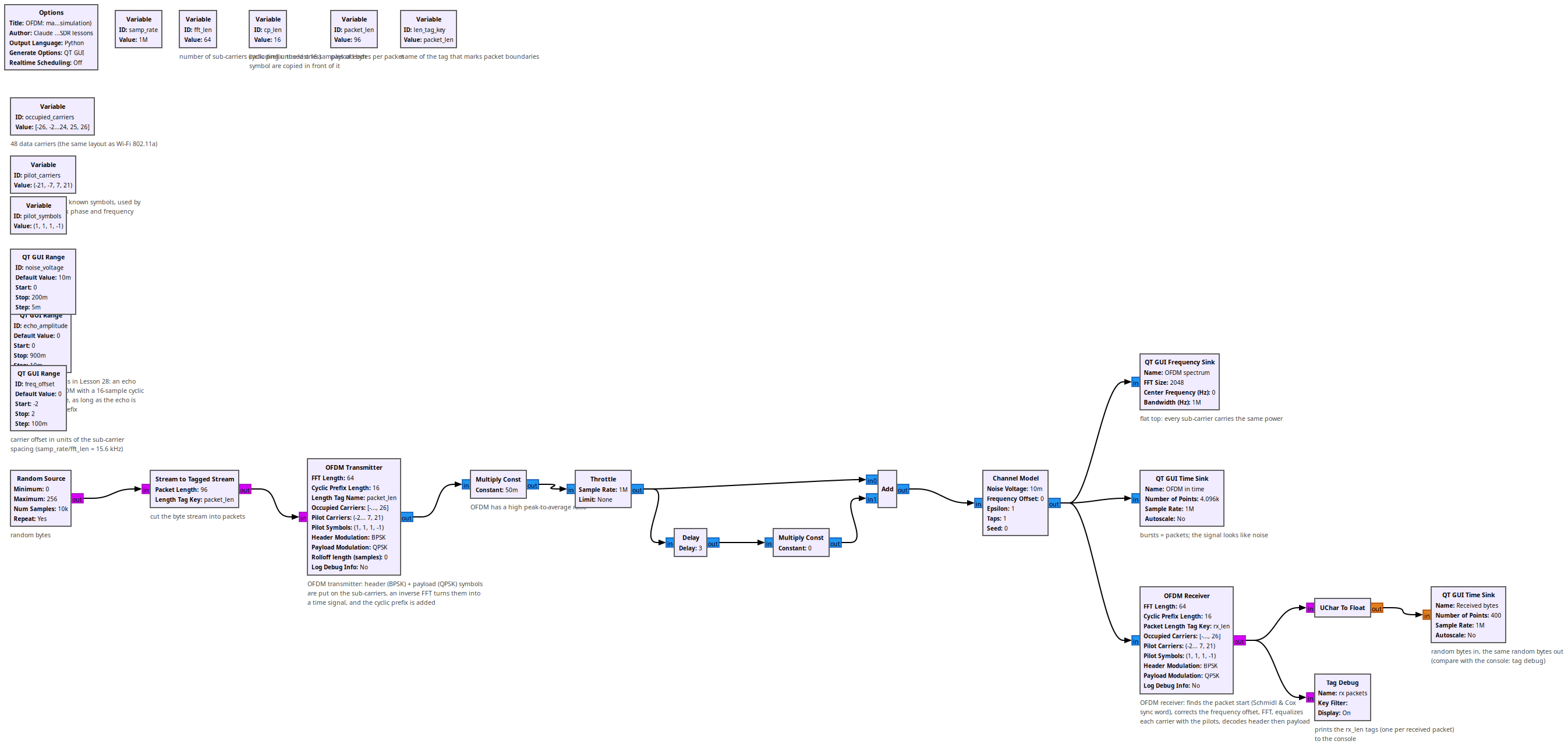
Running: flat-topped OFDM spectrum, bursty time signal, and the decoded payload bytes:
Other flowgraphs for this lesson:
lesson30b_OFDM_Pluto_to_RTL.grc— over the air, Pluto to RTL-SDR at 915 MHz: packets decode (packet_num tags on the byte plot)
All GNURadio flowgraphs are at https://github.com/gallicchio/learnSDR