Learn SDR
Harvey Mudd College
Lesson 32 — What a receiver sees when nothing is there: noise
No video for this lesson. Lessons 24–38 were drafted in October 2026 with the help of an AI assistant (Claude) in the spirit of the lessons above, and tested on the same RTL-SDR / PlutoSDR / B210 setup. They are less polished than the video lessons; corrections and pull requests are welcome.
(The two flowgraphs are Jason’s from 2021; only this page is new.)
Disconnect the antenna and a receiver still produces samples: noise, from the thermal motion of electrons in the amplifiers and from the digitizer itself. lesson32a_noiseRXpluto.grc shows the Pluto’s, lesson32b_noiseRXsim.grc makes the same picture with GNU Radio’s Noise Source.
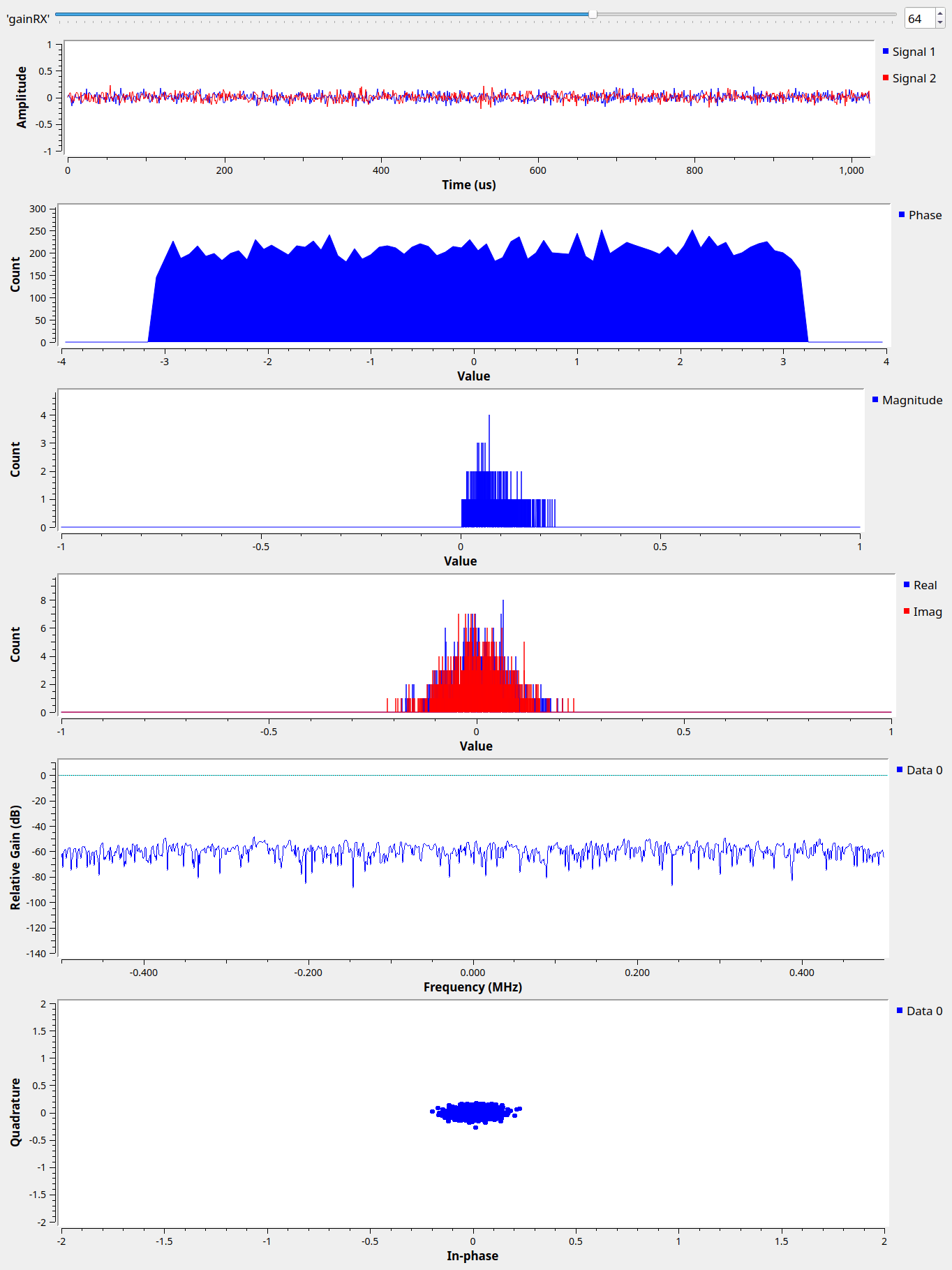
- The histogram of the real part is a Gaussian bell: lots of independent small contributions. Its width is the noise voltage; the spectrum sink’s flat floor is the same thing per frequency bin.
- Turn the RX gain up and the floor rises: you are amplifying the front end’s noise. Turn it far down and the floor stops dropping and the histogram becomes “steppy”: you are now looking at the ADC’s quantization (the RTL-SDR has 8 bits, the Pluto 12).
- A signal is detectable when it sticks out of this floor. Averaging more FFTs (the sink’s “average” setting) does not lower the floor, it only makes it smoother; narrower FFT bins (a bigger FFT size) do lower the noise per bin, by 3 dB per doubling, because less noise falls into each bin while a tone stays in one bin. That is how Lesson 23 digs GPS out from 20 dB below the floor: by correlating over a millisecond, which is equivalent to a 1 kHz bin.
Things to try
- Compare the floor with the antenna connected and disconnected. If it rises with the antenna, your environment (or the antenna’s own pick-up) dominates and more gain would not help.
- With the Pluto, set the gain to 0, 30 and 70 dB and note the floor each time. Where does the slope become 1 dB per dB?
Flowgraphs
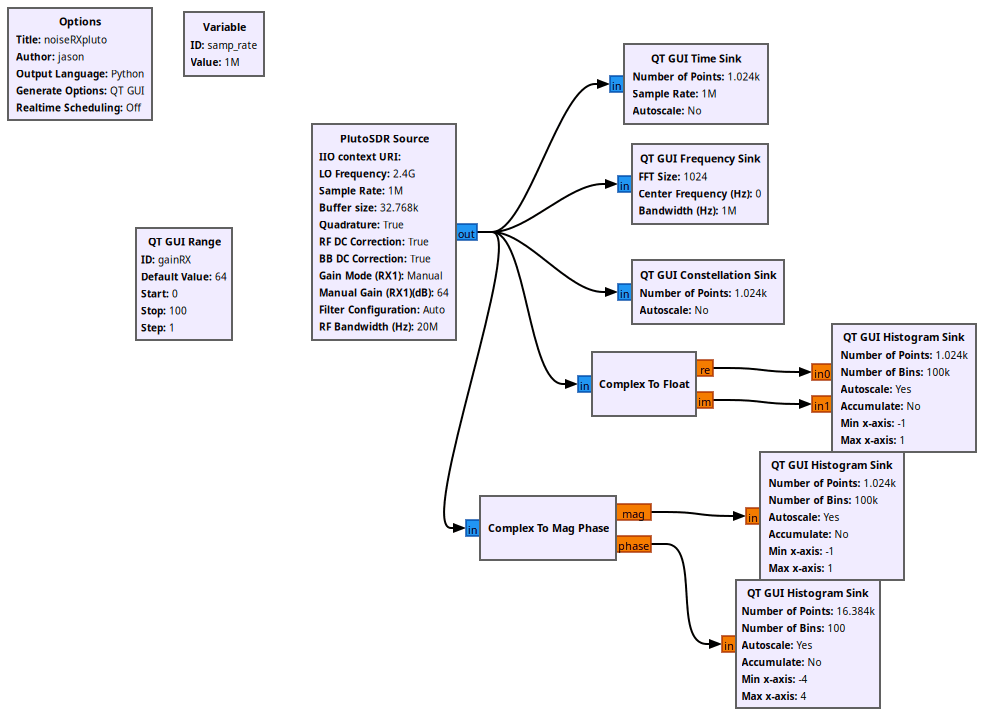
Running: the Pluto with nothing connected:
Other flowgraphs for this lesson:
All GNURadio flowgraphs are at https://github.com/gallicchio/learnSDR