Learn SDR
Harvey Mudd College
Lesson 34 — Filters: low-pass, high-pass, band-pass, transition width and decimation (simulation)
No video for this lesson. Lessons 24–38 were drafted in October 2026 with the help of an AI assistant (Claude) in the spirit of the lessons above, and tested on the same RTL-SDR / PlutoSDR / B210 setup. They are less polished than the video lessons; corrections and pull requests are welcome.
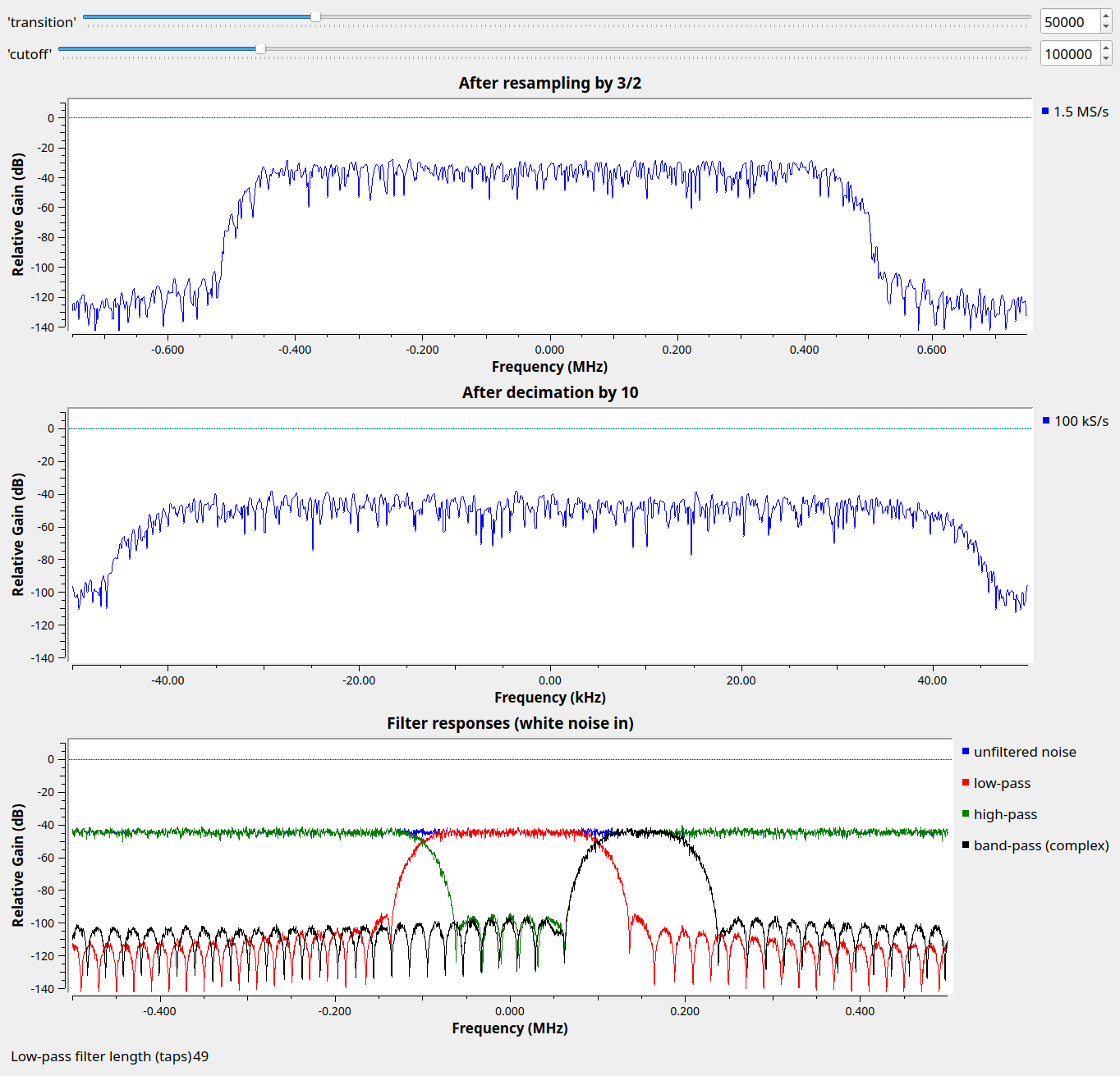
Every lesson has used a Low Pass Filter block; this one looks at what the filter parameters mean. White noise (equal power at every frequency) goes in, so the output spectrum is the filter’s frequency response.
- Cutoff is where the filter starts to roll off; transition width is how far it takes to get from passing to blocking. A sharper transition needs a longer filter: the number of taps is roughly \(4 f_s/\Delta f\) (with the Hamming window), and every output sample costs one multiplication per tap. Halve the transition width and watch the tap count double; set it to 2 kHz and watch the CPU meter.
- A high-pass filter is the same thing upside down. A band-pass filter with real taps keeps both \(+f\) and \(-f\); with complex taps (used here) it can keep positive frequencies only — the difference between a real and a complex signal again (Lesson 3b).
- Decimation: after a low-pass filter you can throw samples away. The cutoff must be below the new Nyquist frequency (\(f_s/2D\)), otherwise what is above it folds back in (Lesson 6). The decimating filter only computes the outputs it keeps, so a decimate-by-10 filter costs a tenth of the CPU. This is why Lesson 1 filters then decimates before the FM demodulator.
- The Rational Resampler changes the rate by 3/2: insert zeros, low-pass, keep one in two, done as a single polyphase filter (the same trick as Lesson 18’s filter bank).
Things to try
- Set the transition width to 2 kHz and the FFT size large: how many taps, and how does the filter edge look?
- Rectangular vs. Blackman window at the same width: compare the stop-band ripple.
- Raise the decimating filter’s cutoff above 50 kHz and watch the aliasing.
Flowgraphs
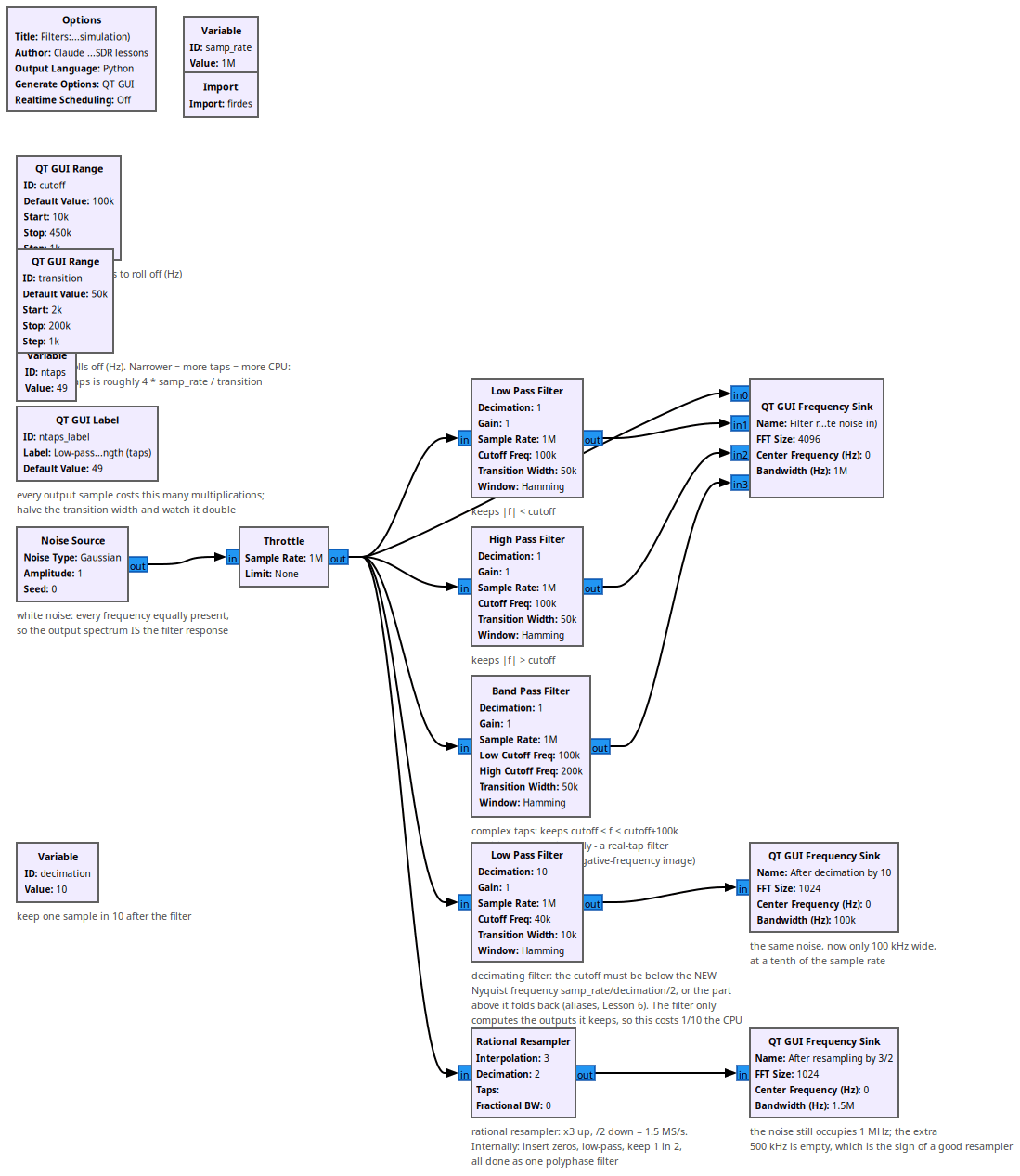
Running: low-, high- and band-pass responses measured with white noise, the decimated and the resampled spectra:
All GNURadio flowgraphs are at https://github.com/gallicchio/learnSDR