Learn SDR
Harvey Mudd College
Lesson 38 — A real standard: DVB-S2, the satellite-TV waveform, from Pluto to RTL-SDR
No video for this lesson. Lessons 24–38 were drafted in October 2026 with the help of an AI assistant (Claude) in the spirit of the lessons above, and tested on the same RTL-SDR / PlutoSDR / B210 setup. They are less polished than the video lessons; corrections and pull requests are welcome.
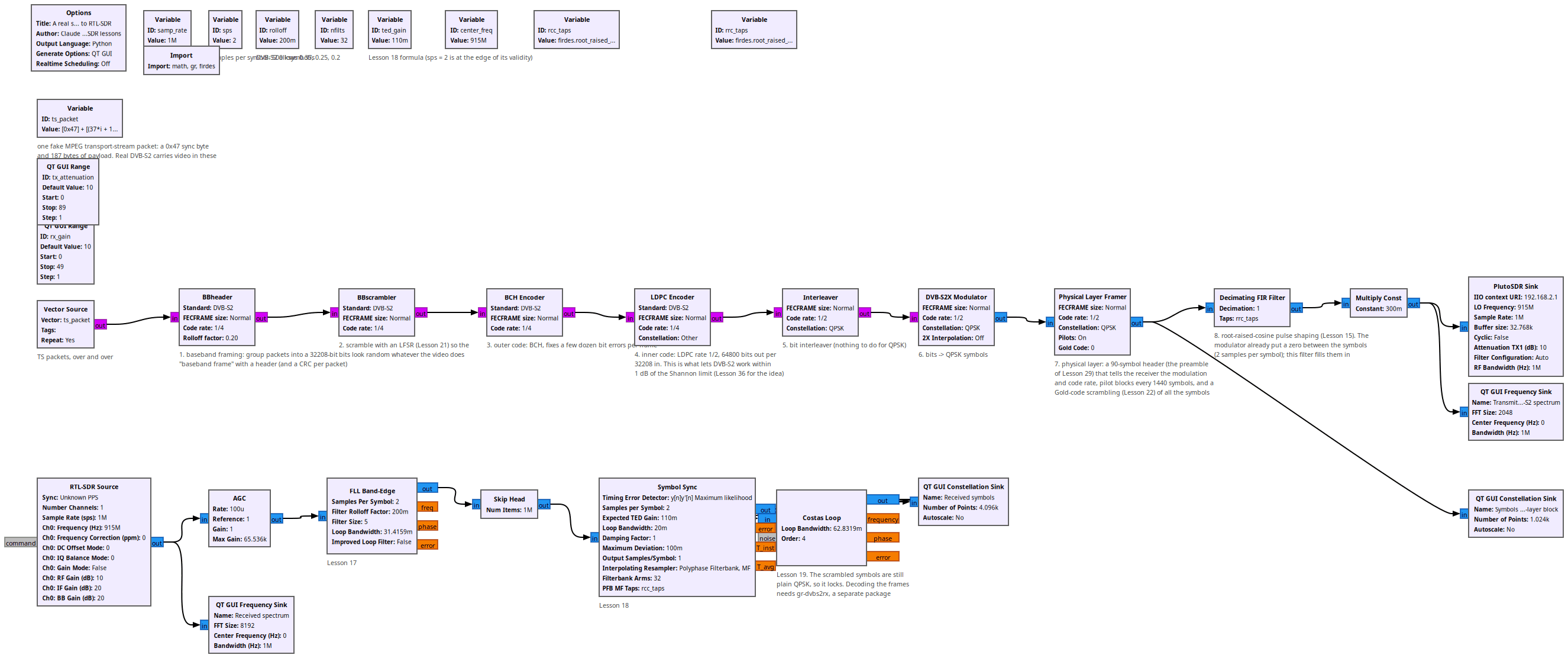
Everything in Lessons 12–36 is in a modern standard, usually all at once. DVB-S2 (digital satellite television, also used for data links) is a good example because GNU Radio ships its complete transmitter. The flowgraph sends fake MPEG transport-stream packets through it:
- BBHeader: packets are grouped into a baseband frame with a header.
- BBScrambler: an LFSR (Lesson 21) scrambles the bits so they look random.
- BCH encoder: an outer code that cleans up the last few errors.
- LDPC encoder: the inner rate-1/2 code, 64800 bits per frame — the reason DVB-S2 works within a dB of the Shannon limit (Lesson 36 for the idea).
- Interleaver and 6. Modulator: bits to QPSK symbols (8PSK, 16APSK and 32APSK are available).
- Physical layer: a 90-symbol header that tells the receiver the modulation and code rate (Lesson 29’s preamble), pilot blocks every 1440 symbols, and Gold-code scrambling of all symbols (Lesson 22).
- Root-raised-cosine pulse shaping with roll-off 0.2 (Lesson 15), at 500 ksymbol/s here.
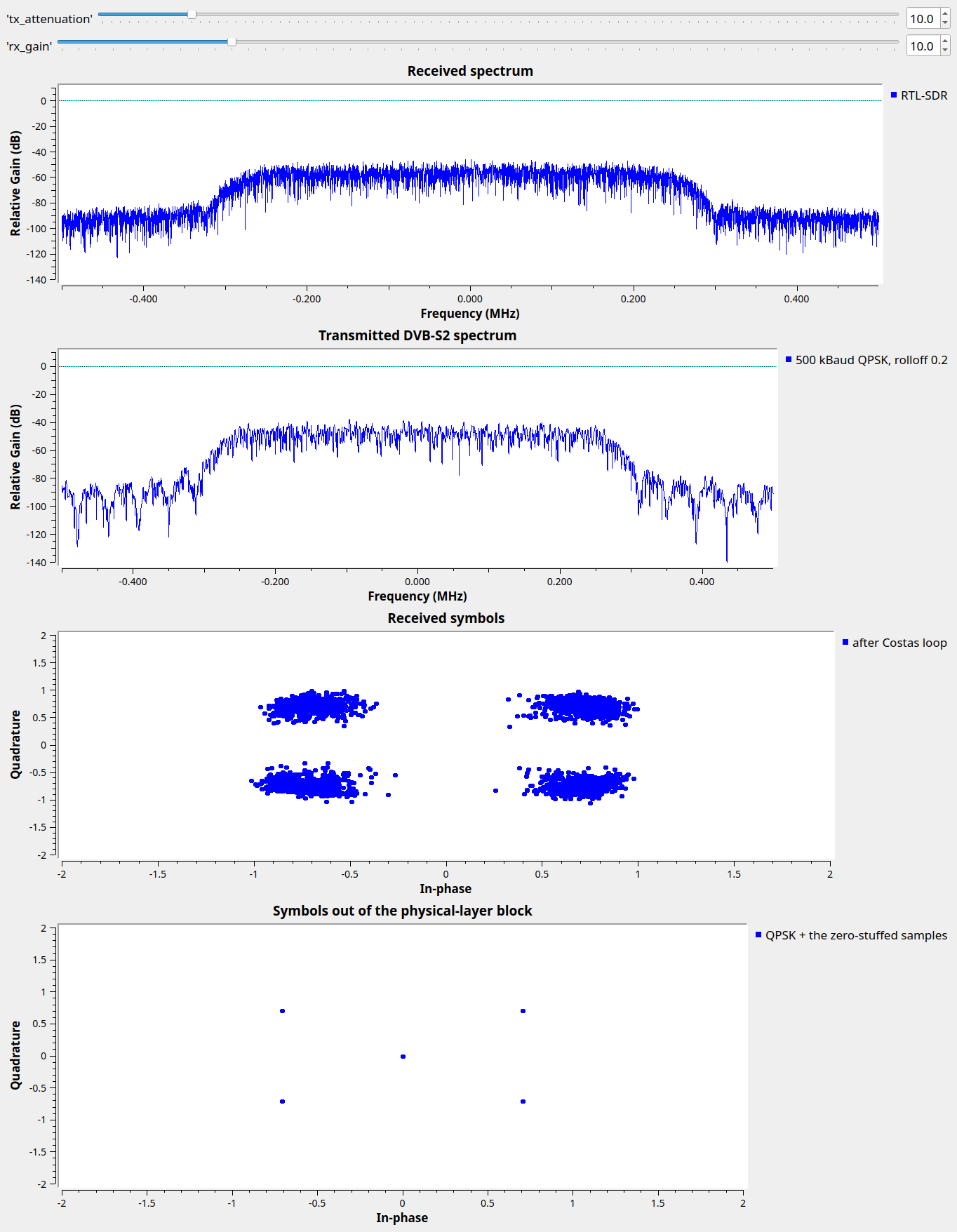
The receiver side is our own chain from Lessons 17–19 (AGC, FLL, Symbol Sync, Costas loop). Because the scrambling only rotates symbols by multiples of 90°, the result is a clean QPSK constellation. (The GNU Radio modulator emits its symbols with a zero sample between them, i.e. already at 2 samples per symbol, which is why the pulse-shaping filter is an ordinary FIR filter rather than an interpolating one: filtering fills in the zeros, Lesson 6.) Decoding the frames themselves needs the gr-dvbs2rx out-of-tree module; with it, or with any satellite-TV receiver chip, this signal is a valid DVB-S2 transmission.
Things to try
- Switch the modulator and physical-layer blocks to 8PSK (the LDPC block’s constellation must match).
- Change the code rate to 9/10 and watch nothing visible change: the symbol stream looks the same, only its robustness differs.
- Receive a real satellite: a DVB-S2 LNB and dish on the RTL-SDR, and
gr-dvbs2rx.
Flowgraphs
lesson38_DVBS2_Pluto_to_RTL.grc
Running over the air: the DVB-S2 spectrum at the RTL-SDR and the QPSK constellation after our Lesson 17-19 receiver:
All GNURadio flowgraphs are at https://github.com/gallicchio/learnSDR